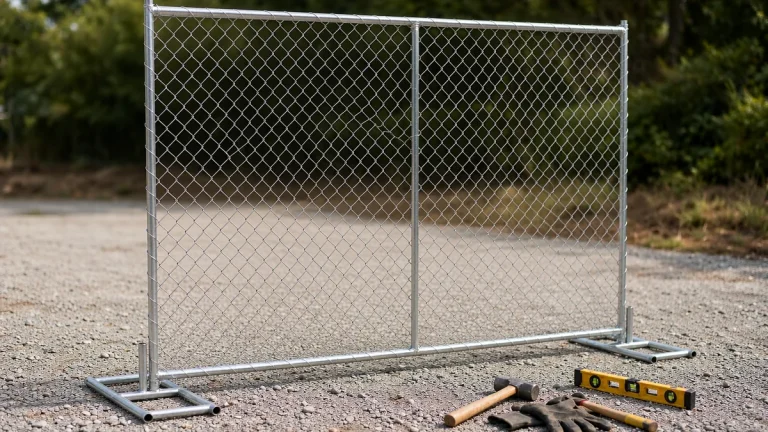
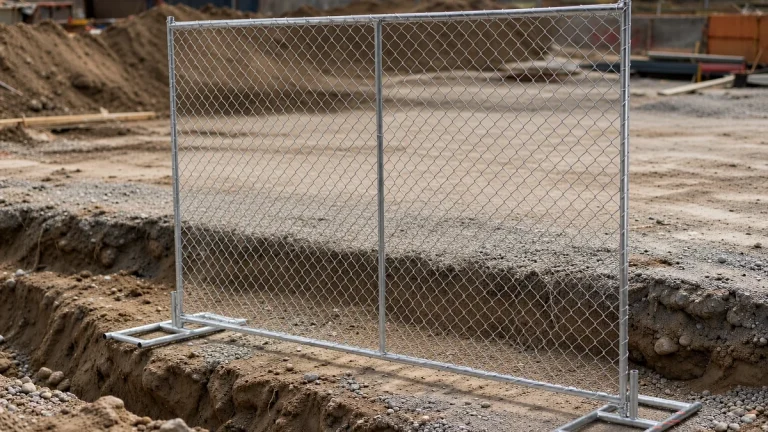
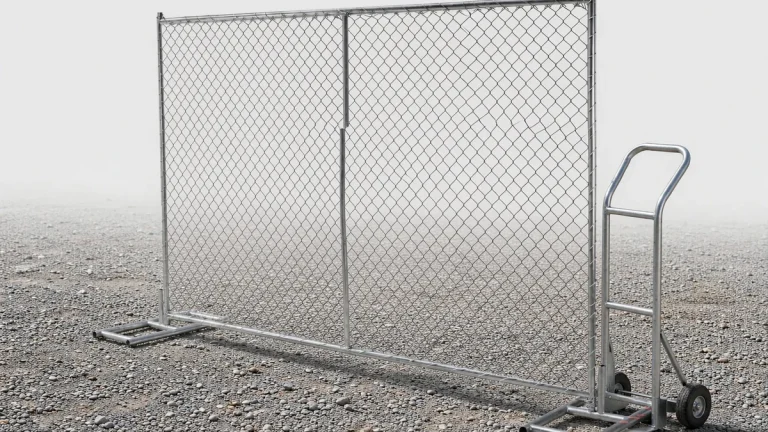
A fence rental business should stock matching couplings and fasteners, feet and base pins, complete gate hardware sets, approved braces and anchors, repair materials, screen and sign fixings, and replacement panels and gates. Set quantities from confirmed losses, rejected parts and supplier lead times. Keep the equipment needed to erect each job separate from the reserve used to replace damaged or missing items.
Start with the parts whose absence would stop a booked job: connectors, bases, gate hardware and any supports required by its installation plan. A required brace or anchor is just as important as a coupling. Add repair materials and complete replacement units according to repair turnaround and the cost of leaving a job short.
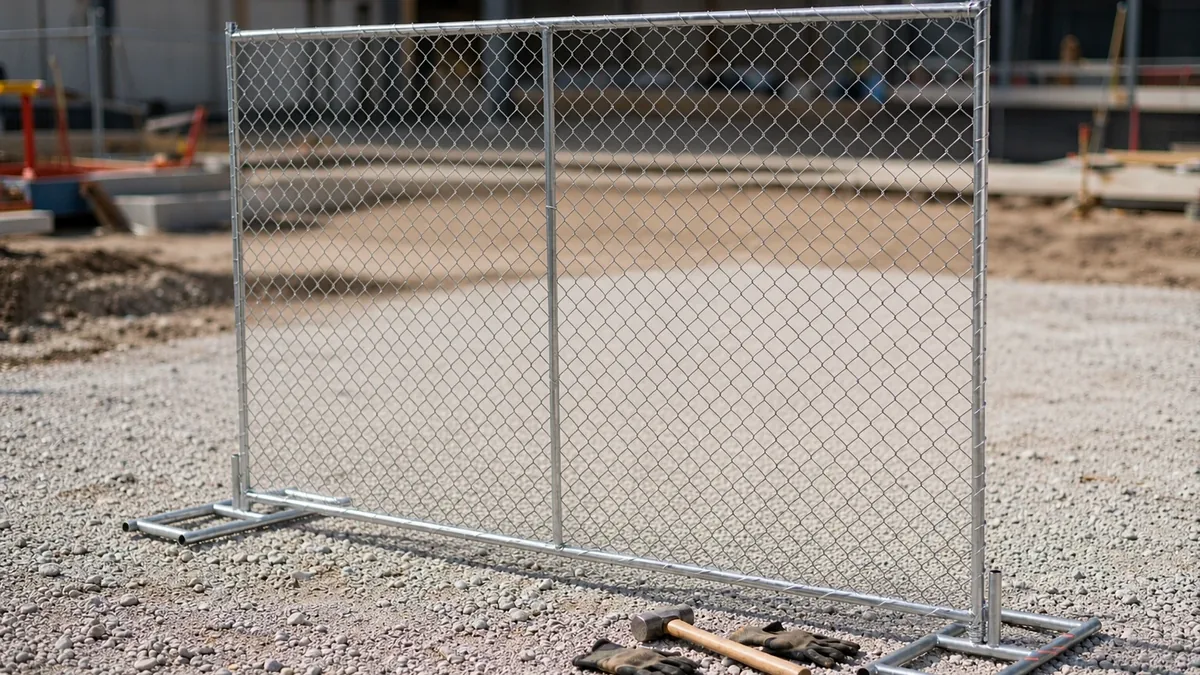
The spare parts to keep on hand
| Part group | What to stock | What determines the quantity |
|---|---|---|
| Panel connections | Compatible couplers, clamps, bolts, nuts and specified washers, including corner and end fittings | Connections in use, confirmed losses and inspection rejects. WorkSafe Victoria calls for securely connected gates and joints without weak points for entry. Construction site security fencing |
| Feet and bases | The correct base, socket, retaining pin and other fittings for each panel system | Actual bases deployed and their replacement history. Shared feet, ends, corners and gates can change the count; one base per panel is not a universal rule. |
| Gate hardware | Matched hinges, hinge pins, latches, drop rods, keepers and any specified closer | Gate types in the fleet and complete sets needed during repairs. HSE guidance says gates should be securable in both open and closed positions. Hsg151.htm |
| Bracing and anchoring | Approved braces, stays, pins, anchor fittings and ballast-system components | The site-specific installation arrangement, followed by replacement records. ASTM F3342-19 warns that screening needs wind-load design; its warning is not a product wind rating. F3342 19 |
| Repair materials | Compatible mesh, approved frame components and coating-repair materials | Repairs your workshop is equipped and authorized to perform, plus the time needed to return parts to service |
| Screen and sign fixings | Specified ties, clips and brackets | The approved fixing layout and replacement demand. Signage and shade cloth can require additional support against wind loads. Construction site security fencing |
| Complete panels and gates | Serviceable units matching the booked fleet | Expected withdrawals during repair or replenishment, bookings and the availability of compatible substitutes |
Use the job’s parts schedule to count its feet, clamps, braces, ballast and anchors. Haisen’s temporary fence installation guide covers those planning inputs. Do not derive anchor spacing or ballast weight from a spare-parts percentage.
How many spare parts should you stock?
Separate deployed equipment from replacement demand
For each part number, track serviceable stock, stock allocated to jobs, items awaiting inspection, repairable items and permanent withdrawals. Only serviceable, unallocated parts are available for the next dispatch.
For example, 100 panels physically in the yard minus eight awaiting repair and two withdrawn leaves 90 serviceable panels. A booking for 95 is five short before any allowance for other reservations. This is illustrative arithmetic, not a fleet record.
Count fittings out and back against the same job sheet. A difference is initially a shortage to investigate: it may be a loss, an incomplete return or a transfer to another site. Record permanently lost parts and inspection rejects separately. A damaged fitting returned to the yard can create replacement demand even though the return count balances.
A worked replacement example
Assume 300 serviceable panels are deployed as 20 separate open runs of 15 panels. Each run has 14 panel-to-panel joints, giving 280 internal joints. Assume one coupling assembly at each internal joint; end fittings, corners and gates are counted separately. Systems requiring more connectors per joint need a different count.
The following rates are hypothetical planning inputs. They are not industry averages, product failure rates or recommended installation ratios.
| Part | Illustrative replacement calculation | Whole units for one cycle |
|---|---|---|
| Coupling assemblies | 280 deployed assemblies × 4% = 11.2 | 12 assemblies, rounding upward |
| Coupling fasteners | One matched bolt-and-nut set per replacement assembly in this example | 12 sets, with the washers required by that assembly |
| Bases | 300 actual deployed bases assumed for this example × 1% = 3 | 3 compatible bases |
| Gate hardware sets | 10 deployed gate sets assumed × 10% = 1 | 1 complete matching set |
Over ten equivalent cycles, expected coupling demand is 280 × 0.04 × 10 = 112 assemblies before a safety allowance. Rounding each cycle to 12 gives a conservative allocation of 120; it is not the same calculation. Neither figure means that the entire season’s demand must sit on the shelf at once.
Braces and anchors require their own deployed counts and replacement records. Fifteen braces installed on jobs are 15 pieces of working equipment, not 15 braces consumed every hire. Track reusable anchors separately from any anchors specified for single use.
Set the reorder point
Reorder point = expected replacement demand during replenishment lead time + safety stock. Use lead time through receipt and acceptance, rather than the supplier’s dispatch date alone. Set the safety allowance from demand variation, delivery reliability and the consequences of a shortage.
Suppose coupling demand averages four assemblies a week, replenishment takes six weeks and you choose eight assemblies as safety stock. The reorder point is (4 × 6) + 8 = 32 assemblies. These are illustrative assumptions. Reorder when your inventory position—usable reserve plus confirmed incoming stock minus outstanding replacement commitments—reaches that level.
If you review stock every two weeks, an illustrative order-up-to target is 4 × (6 + 2) + 8 = 40 assemblies. Order the difference between that target and your inventory position, allowing for pack sizes. Keep installation kits for booked jobs outside this replacement-reserve calculation.
Match spares to the actual fence system
A panel’s overall width does not establish which clamp fits its frame. Haisen’s temporary fence product page lists nominal 6 ft high panels in 6 × 8, 6 × 9.5 and 6 × 10 ft sizes, outer frames of 25 × 25 or 30 × 30 mm, and middle pipes of 20 × 20 or 25 × 25 mm. Specify the section the connector actually grips, together with the approved connector design.
The published welded-panel options include wire diameters of 3.0, 3.5 and 3.8 mm and openings of 50 × 100, 50 × 150, 50 × 200, 75 × 100 or 75 × 150 mm. Confirm the exact combination on your existing panels. A roll from the welded wire mesh range is not automatically an approved replacement infill.
Height also needs checking against the application. Six feet is approximately 1.83 m. WorkSafe Victoria’s guidance uses at least 1.8 m; HSE describes a 2 m fence as an effective barrier for most sites. Meeting a height figure alone does not establish site suitability or structural performance. Construction site security fencing Hsg151.htm
| Item | Details to put on the purchase order |
|---|---|
| Couplers and clamps | Manufacturer’s part number or approved drawing, frame section, clamp geometry, bolt arrangement and finish |
| Bolts, nuts and washers | Diameter, pitch, length, specified property class, coating, compatible thread tolerances and washer specification |
| Bases and retaining pins | Base type, socket dimensions and spacing, pin dimensions, compatible panel and approved application |
| Gate hardware | Gate model, hinge size, handing where relevant, latch and keeper arrangement, pins and retaining devices |
| Braces, anchors and ballast fittings | Approved system reference, connection details, substrate or ground conditions and installation instructions |
| Repair materials and replacement units | Panel model, material, wire and frame dimensions, finish and approved repair method or replacement specification |
Keep a labeled reference sample or dimensioned drawing for each approved assembly. Label bins by part number and compatibility, not color alone. Two green clamps can fit different frames; two silver bolts can have different coatings and thread systems.
Buy galvanized fasteners as compatible sets
Hot-dip galvanizing changes thread clearance. ISO 10684:2004 describes two matching routes: nuts tapped oversize to 6AZ or 6AX after coating with bolts made to thread position g or h before coating, or bolts undersized to 6az before coating with nuts tapped to H or G after coating. 36897
Do not pair an oversize nut marked Z or X with an undersized bolt marked U. ISO 10684 explicitly warns that this combination has a high probability of thread stripping. These marks identify alternative systems, not marks to look for together in one assembly. Order the specified matched set and keep the systems in separate bins. 36897
The same standard does not recommend hot-dip galvanizing threaded fasteners smaller than M8 or with pitches below 1.25 mm. That is not a ban on stocking smaller fasteners with a suitable specified finish. Electroplated coating systems are covered by ISO 4042; do not substitute an electroplated bolt for a hot-dip galvanized one merely because both look zinc-coated. 36897 77913
Use the fence supplier’s specified fastener grade and tightening instructions. A bolt’s tensile or proof load does not establish the capacity of the clamp, thin-walled frame, complete joint or fence.
Inspect deliveries and rental returns
Use a receiving sheet with the order number, part number, quantity, batch identification, condition and acceptance decision. Haisen’s storage and transport guide illustrates a delivery shortage as 80 clamps dispatched and 76 received: four short. Treat it as a counting example, not a documented customer incident.
- Reconcile the count. Compare the order, packing list and physical receipt. Keep shortages separate from damaged items.
- Confirm compatibility. Check the part number and dimensions against the approved sample or drawing. Check assembly fit using the supplier’s acceptance procedure; a fit check alone does not prove load capacity.
- Check fastener identity. Confirm the specified grade, finish and matching thread system. Isolate mixed or unidentified hardware.
- Inspect condition. Look for cracks, distortion, damaged threads, broken wires, sharp ends, missing retainers and coating damage.
- Record release or hold. Put accepted items in serviceable stock. Label and separate anything awaiting investigation or repair.
Turn return inspections into stock records
For each job, record quantities dispatched, returned, transferred, still on hire, confirmed lost, repairable and rejected. Include the observed defect and a photograph where useful. Record the cause as unknown unless there is evidence; a bent coupler alone does not prove a vehicle strike.
In an illustrative return, 100 couplers go out and 96 come back. After reconciliation, four are confirmed lost, while three of the returned couplers fail inspection. Immediate replacement demand is seven. If the three damaged couplers are later repaired and accepted, record their return to usable stock so they do not trigger duplicate purchases.
Compare replacement rates for the same part and exposure basis, such as replacements per 100 dispatched assemblies per hire cycle. Review repeat failures by site, handling method and part batch before increasing stock. A compatibility or handling problem needs correction as well as spare parts.
Store parts and monitor corrosion
Use labeled bins for fittings and a suitable rack for panels. Keep serviceable stock separate from returns awaiting inspection. In US construction work, OSHA requires tiered materials to be secured against sliding, falling or collapse and aisles and passageways to remain clear. Apply the storage rules relevant to your own workplace. 1926.250
Keep parts off the ground in dry, ventilated storage, and avoid trapping water between closely packed pieces. Atmospheric corrosion depends on moisture exposure, airborne salinity and pollution; a coastal address alone does not establish a corrosion category or replacement rate. ISO 9223 classifies atmospheric corrosivity using defined exposure information. 53499
Do not divide zinc coating thickness by a first-year corrosion rate to set a replacement date. ISO 9223 states that first-year rates cannot simply be extrapolated to predict long-term corrosion. Conditions in a packed bin or crevice also differ from an exposed standard specimen. Use inspections and actual withdrawals to adjust reserve stock. 53499
For repeated coating damage, ask the supplier about a suitable coating system and repair procedure. Haisen’s galvanized and powder-coated panel guide explains the purchasing considerations; a finish name alone does not provide a service-life guarantee.
Decide what can be repaired
Separate coating damage from structural damage. Quarantine cracked welds, distorted sockets, damaged hinges and stripped threads until assessed against the manufacturer’s repair or replacement criteria. Replacing a bent bolt is not enough if its clamp or frame connection is also damaged.
ISO 1461 covers hot-dip galvanized coatings on fabricated iron and steel articles. Its exclusions include continuously galvanized sheet, wire and mesh, tube and pipe galvanized in automatic plants, and products such as fasteners covered by specific standards. A welded panel or tube component is not excluded merely because of its shape; the manufacturing process and applicable product standard matter. 81435
Its limits for renovation by the galvanizer—total uncoated area no greater than 0.5% and individual areas no greater than 10 cm²—are not rental-fleet scrap thresholds. The standard addresses re-galvanizing larger areas unless otherwise agreed, rather than declaring the article scrap. It also permits suitable zinc-containing repair materials. Use an approved maintenance procedure for in-service damage and assess remaining structural condition separately. 81435
Keep approved coating-repair materials with their preparation and application instructions. Release a repaired part only after the required inspection. If an approved repair cannot restore its required function, withdraw it and use a compatible replacement.
Adjust the list for chain-link and animal enclosures
Chain-link fence systems
Depending on the system, chain-link spares can include tension bars and bands, brace bands, tie wires, clips, caps, rail ends, sleeves and truss-rod components. ASTM F626 covers these categories of chain-link fittings. Stock only the components used by your fleet; a portable framed panel does not necessarily use the same fittings as a post-driven fence. F0626 14r23
Keep multi-part fittings in labeled kits with a contents list. Confirm connectors and feet against the actual model in the chain-link temporary fence range, rather than assuming that welded-panel hardware will interchange.
Dog enclosure rentals
Keep animal-enclosure repair materials separate from construction-fence spares. England’s statutory guidance for licensed dog boarding requires lockable external doors and gates, surfaces without injurious edges, and wire at least 2 mm in diameter where dogs have access to mesh. Square mesh must not exceed 50 × 50 mm, and chain link must not exceed 75 × 50 mm. Dog kennel boarding licensing statutory guidance for local authorities
The listed 50 × 100 mm and larger welded construction-panel openings do not satisfy that square-mesh limit. Stock compatible latches, hinges and properly finished repair mesh for the enclosure being hired. Haisen’s kennel buying guide covers the relevant product details. The English boarding guidance does not establish requirements for every dog run, other species or other jurisdictions; check the intended use before specifying replacements.
Build the next order from your records
List each approved part number, usable reserve, confirmed incoming quantity, replacement commitments, replenishment lead time and reorder point. Check complete gate and connector kits before counting them as available. Keep a separate list of equipment committed to upcoming installations.
The numerical stock examples above are hypothetical. Product dimensions come from Haisen’s published specifications; the cited standards and guidance support their stated technical points within their own scope and jurisdiction. They do not supply fleet loss rates or certify a particular fence installation. Obtain project-specific load, anchoring and compatibility information from the system supplier before ordering substitutes.
Send Haisen your panel models, frame dimensions, existing hardware photos and required quantities to request a compatible spare-parts quotation.
Request a spare parts listReferences
- WorkSafe Victoria. Construction site security fencing.
- Health and Safety Executive. HSG151, Protecting the public, paragraphs 37 and 39.
- ASTM International. ASTM F3342 Standard Guide for Temporary Fence Applications for Construction Sites, significance and use, including Note 1.
- International Organization for Standardization. ISO 10684:2004 — Fasteners: Hot dip galvanized coatings, scope and clause 6.2.
- International Organization for Standardization. ISO 4042:2022 — Fasteners: Electroplated coating systems, scope.
- OSHA. 29 CFR 1926.250, General requirements for storage, paragraphs (a)(1) and (a)(3).
- International Organization for Standardization. ISO 9223:2012 — Corrosivity of atmospheres: Classification, determination and estimation, scope and clause 7.
- International Organization for Standardization. ISO 1461:2022 — Hot dip galvanized coatings on fabricated iron and steel articles: Specifications and test methods, scope and clause 6.3.
- ASTM International. ASTM F626 Standard Specification for Fence Fittings, scope.
- Department for Environment, Food and Rural Affairs. Dog kennel boarding licensing statutory guidance for local authorities, England.