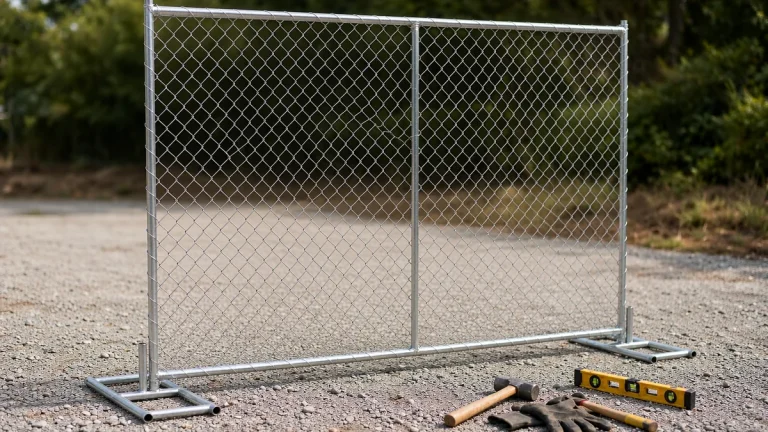
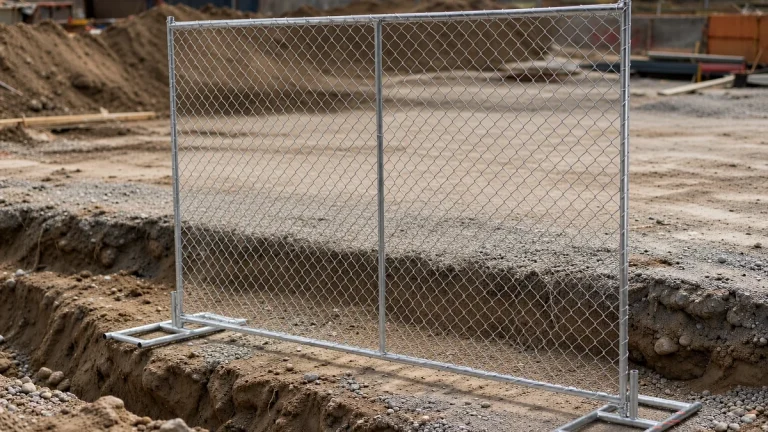
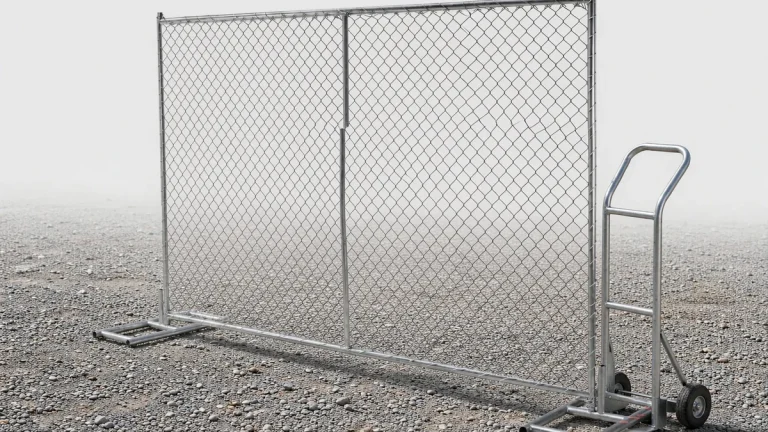
Lock a temporary construction gate with a compatible lockable latch or a hasp and padlock secured to the gate frame and its receiving post. Close and align the gate first, engage the latch, then lock the hardware so the leaf cannot swing open or slip free. For a double gate, secure the inactive leaf with its specified drop bolt before locking the leaves together.
Check the escape route before applying a padlock. An ordinary padlocked hasp or chain must not prevent anyone leaving an occupied area through a required exit. Use an exit arrangement selected for the site’s fire and evacuation plan. UK construction guidance requires identified escape routes to remain available and unobstructed.Generalfire.htm
A latch holds a closed gate; a closer moves the gate toward the closed position. A self-latching catch does not, by itself, make the gate self-closing. Where automatic closing is needed, specify compatible closing hinges or a gate closer as well as the latch.
Choose the locking arrangement for the gate
The right arrangement depends on the gate’s use, the receiving hardware and whether people need to escape through it. A larger padlock will not compensate for loose hinges, removable fixings or an unstable gate post.
| Gate or operating condition | Suitable arrangement to specify | Check before use |
|---|---|---|
| Single pedestrian gate, not a required exit | Lockable gate latch or a hasp and padlock fixed to suitable structural members | Latch alignment, mounting strength and whether the locked leaf can be lifted or slipped free |
| Pedestrian gate needing automatic closing | Compatible closer or closing hinges plus a self-latching catch; access control as required | Closing and latching over the manufacturer’s stated operating range |
| Double-leaf access gate | Specified drop bolt and keeper for the inactive leaf, with a latch or lockable fitting joining the leaves | Both leaves remain retained; the bolt cannot be released from the unauthorised side |
| Vehicle gate used after hours | Purpose-made lockable gate hardware; a chain and padlock only where the gate design allows it | Chain captures the intended structural members and cannot slip off; no loose loop crosses the walking route |
| Gate on a required escape route | Suitable escape hardware that preserves the required inside release | No padlock, chain or secondary bolt defeats the escape function |
| Solid hoarding gate | Hardware and supports selected for the actual leaf and site loads | Gate weight, wind exposure, hinge capacity, post support and closing control |
A vehicle gate controls access; an ordinary temporary fence gate, chain or wheel stop is not a crash-rated vehicle barrier. Keep pedestrian access separate from vehicle movements where practicable. HSE construction guidance recommends separate entry and exit gateways for pedestrians and vehicles.Vehiclestrafficmanagement.htm
Fit and check the lock step by step
- Identify the gate’s role. Mark whether it is a pedestrian entrance, vehicle entrance or required exit. Establish who needs access during work, after hours and during an emergency. Select the locking arrangement around those uses.
- Check the gate and supports. Confirm that posts, feet, connectors, hinges and braces match the installation plan. Open and close the leaf by hand. Correct dragging, sagging or moving supports before adjusting the lock. The guide to temporary fence feet that move explains the base checks to include.
- Fit compatible receiving hardware. Install the latch, keeper, hasp or locking brackets on the members specified by the gate supplier. Use the approved fasteners and mounting details. Do not drill or weld a thin tube frame without confirming the detail and any required coating repair.
- Set the alignment. The latch should engage without lifting, kicking or forcing the leaf. On a double gate, seat the inactive leaf’s drop bolt in its intended socket before aligning the main latch. Confirm that the socket stays usable and does not create a trip hazard.
- Fit the padlock to the hardware. Check shackle diameter, internal width, internal height and room for the lock body and key. Close the lock through the intended eyes or staple. Do not use mesh openings as the mounting point or as the rule for choosing padlock size.
- Check retention and release. With the gate locked, check for unintended movement and visible ways it could slip out of its fittings. Inspect hinge retention and accessible fixings. Test any required inside release with the complete locking arrangement in its normal operating state.
- Test automatic closing if fitted. Follow the closer manufacturer’s instructions for opening positions, adjustments and acceptance checks. Confirm that the leaf reaches the keeper and latches. Keep hands clear of pinch points. A latch catching when the leaf is pushed shut is not evidence that the closer works.
- Record the handover. Record the gate ID, lock and key references, hardware models, inspection date and defects corrected. Allocate keys or codes to authorised users, define spare-key custody and explain the closing procedure to the people using the entrance.
These are installation and functional checks, not a proof-load test or a security certification. Use the supplier’s instructions for fastener torque, adjustment and maintenance intervals.
Size the padlock from the locking hardware
There is no universal padlock size for a temporary construction gate. Measure the fitting the lock must pass through, then compare it with the lock manufacturer’s dimensional drawing.
| Dimension or detail | What to compare | Why it matters |
|---|---|---|
| Shackle diameter | Diameter of the shackle bar against the clear hole in each eye or staple | The shackle must enter and close without forcing |
| Internal shackle width | Clear distance between the shackle legs against the fitting arrangement | Determines whether the shackle can surround the intended parts |
| Internal shackle height | Clear depth under the shackle against the combined fitting thickness and offset | Determines whether the lock reaches around the assembly |
| Lock body clearance | Space around the hasp, frame and adjacent panel | The body must not prevent full engagement or obstruct the key |
| Locked assembly | Gate-side and post-side fittings, hinge retention and fasteners | The gate must remain captured when the lock is closed |
Shackle diameter, shackle clearance and padlock body width are different measurements. A product sold as a “40 mm padlock” does not necessarily have a 40 mm shackle opening. Check the drawing rather than relying on the product name.
Haisen’s published welded temporary fence specifications include mesh openings of 50 × 100, 50 × 150, 50 × 200, 75 × 100 and 75 × 150 mm. Those are panel specifications. They do not establish a minimum shackle diameter or show that a particular locked assembly can pass through the mesh.
The published outer frame sections are 25 × 25 or 30 × 30 mm square tube. Frame size helps identify compatible brackets, but it does not establish the tube wall thickness, fastener capacity or suitability for a welded hasp. Confirm those details for the actual gate.
Keep security separate from emergency escape
An outside padlock does not become escape hardware simply because another handle is fitted inside. Every locking component that prevents opening must be compatible with the required escape operation.
For US construction work, OSHA 1926.34(a) requires free and unobstructed egress from occupied buildings or structures and prohibits locks or fastenings that prevent free escape from inside a building, subject to its stated institutional exception. This is a construction egress requirement, not a product approval for a perimeter gate.1926.34
OSHA’s general-industry rule, 1910.36(d), separately states that employees must be able to open an exit route door from inside without keys, tools or special knowledge. It permits a device such as a panic bar that locks only from outside on exit discharge doors. That provision does not establish that an unspecified thumb-turn fitting or gate latch is suitable for every construction exit.1910.36
Before using an after-hours padlock, confirm that workers, cleaners, guards and contractors have left the area it would lock in. If people remain, preserve the escape routes required by the site plan. A key kept in an office or held by one supervisor is not an inside-release mechanism.
Have the person responsible for the site’s fire arrangements confirm the exit route, opening direction, clear width and release hardware under the applicable local requirements. Keep feet, chains, stored panels and the gate’s swing out of the escape path.
Inspect the whole gate assembly
Look beyond the padlock. A locked latch can remain intact while the gate lifts off a hinge, a bracket comes loose or a supporting panel moves. The useful question is whether the closed assembly retains the leaf, not whether the padlock is still attached.
Use a practical opening and closing check when taking over the gate, and repeat the relevant checks after relocation, impact, repairs or a change in ground conditions. Set routine inspection frequency to the site conditions and the equipment instructions.
| Symptom | Possible causes | First action |
|---|---|---|
| The gate must be lifted to latch | Sagging hinges, moving support or misalignment | Check the leaf and supports before moving the keeper |
| A self-closing gate stops short | Closer adjustment, hinge friction, obstruction or unsuitable closer | Check the closer instructions and eliminate interference |
| The padlock closes but the leaf still opens | Fittings do not capture both sides, excessive play or a releasable secondary fitting | Correct the locking arrangement before returning the gate to use |
| The leaf can lift off its hinges | Missing or unsuitable hinge-retention detail | Fit the supplier-specified retention arrangement |
| The key or shackle binds | Load on the lock, debris, corrosion or misalignment | Remove the cause of binding and maintain the lock as its manufacturer directs |
| The inactive leaf moves | Drop bolt not seated, damaged keeper or moving ground support | Restore the intended bolt engagement and support |
| The gate swings into a walkway | Unsuitable swing layout or missing hold-open control | Correct the layout or specified hold-open arrangement without blocking an exit |
A hasp is not automatically an anti-lift device, and a drop bolt does not automatically prevent hinge removal. Check each function in the actual assembly. If a defect compromises boundary security or escape, arrange a controlled alternative while it is repaired.
For rental fleets, keep complete, matching replacement sets rather than a box of visually similar latches. Haisen’s fence rental spare-parts guide covers hinges, hinge pins, latches, drop rods, keepers and specified closers.
Allow for wind, ground conditions and corrosion
The lock does not replace the gate’s structural support. HSE identifies site fencing and hoarding as temporary works and states that, in all but the simplest situations, a design including calculations is needed.Temporary works.htm
A solid leaf or added screening changes the design conditions. Do not add a sheet, banner or screen and assume the existing feet, braces and anchors remain adequate. Record the gate position, swing space and supports in the temporary fence installation plan.
ASTM F3342-19 addresses temporary fencing for construction sites. Its public scope calls for reviewing contract documents, the site plan, local codes and existing site conditions. Its published significance section describes continuous barriers with positive steel connections between panels or supporting posts. This does not prescribe a padlock size or approve a particular hasp.F3342 19
The guide’s screening warning states that the temporary fence described cannot handle 110 mph gusts under the referenced ASCE/SEI 7-10 conditions. It calls for research and design for screening wind loads. This is not an allowable wind speed, a safe operating threshold or a Haisen product rating. The cited information is from ASTM’s public scope and significance text, not the paywalled full standard.F3342 19
Haisen lists hot-dip galvanized and powder-coated panel finishes. Select the lock and fasteners for the actual exposure and compatibility with the mounting materials; matching the panel colour alone does not establish corrosion resistance. Ask for the hardware material, coating specification and maintenance instructions. The panel finish comparison helps frame those purchasing questions, but it is not a lock durability test.
Match the gate to the boundary
A secure lock cannot correct an unsuitable boundary height or an uncontrolled opening beside the gate. HSE says that, typically in populated areas, suitable construction boundaries mean a two-metre-high small-mesh fence or hoarding. It presents this as context-dependent guidance, not a universal statutory minimum.Publicprotection.htm
Haisen’s welded panels have a nominal height of 6 ft, published as approximately 1.83 m. Its chain-link temporary fence range lists 4, 6 and 8 ft enquiry options, approximately 1.22, 1.83 and 2.44 m. Using those rounded metric figures, 1.83 m is 170 mm below 2 m and 2.44 m is 440 mm above it. These are height comparisons, not measured openings above a gate and not evidence of site compliance.
Specify the gate height and actual ground, hinge-side and latch-side gaps on the layout. Keep nearby materials and equipment from providing easy access over the boundary. Choose lock placement around authorised operation, tamper exposure and escape requirements rather than automatically placing every lock outside.
If the gate also separates animals
Construction fencing is not automatically suitable animal containment. Assess the species and size of the animals, mesh and ground gaps, sharp edges, entrapment risks and the possibility of animals reaching the release. Do not assume that every animal can be contained by the same two-movement latch.
WorkSafe Victoria’s cattle-yard guidance identifies latches that fail to catch or release when kicked or struck as hazards. Its controls include self-latching gates, chains as secondary locking mechanisms, regular checks and escape routes. This guidance concerns cattle yards in Victoria, Australia; it does not establish suitability for dogs, poultry or a construction fence product.Safe cattle yards gates and latches
What Haisen’s manufacturing information can establish
Haisen’s company and factory page states that the company was founded in 2017 and manufactures fencing and related wire-mesh products in Raoyang County, Hengshui City, Hebei, China. It describes tube cutting, robotic frame welding and component packing. This is manufacturer-published information about production, not an independent gate-security assessment or a report of a site installation.
The practical purchasing point is to match the hardware to the product being made. The temporary panel page lists square-tube frame options, while the chain-link gate kit page describes a round-frame gate kit. Do not assume that brackets, hinges or latch fittings interchange between those products.
That gate kit page asks for the opening width, gate height, post diameter, ground gap, hinge side and swing direction. Add the intended locking and escape functions to those dimensions before ordering. For help recording them, use the chain-link gate measuring guide.
For a specific order, ask Haisen for the matching drawing, sample and available inspection records. Check that the drawing identifies the gate and post profiles, wall thickness, hinge retention, latch and keeper, fixing positions and padlock clearances. Confirm that any sample and records correspond to the quoted configuration.
The published material does not establish a tested forced-entry resistance, wind rating or salt-spray life for the proposed gate-and-lock assembly. Those claims require evidence for the actual configuration. A factory description or a successful hand-operated latch check cannot substitute for that evidence.
Put a complete gate specification on the order
Use the following as a purchasing template, then replace the placeholders with surveyed dimensions and agreed hardware details.
Gate ID [reference]; use [pedestrian/vehicle]; required escape route [yes/no]; clear opening [width] mm; leaf height [height] mm; leaf and post profiles [dimensions and wall thickness]; ground clearance [dimension and site variation]; hinge side [left/right, viewed from stated side]; swing direction [inward/outward]; hinge-retention arrangement [detail]; latch and keeper [models]; closer [model or not required]; lock or padlock [model and dimensional drawing]; inactive-leaf bolt [detail or not applicable]; mounting and coating repair [approved detail]; inside-release function [requirement]; keys or access credentials [quantity and custody]; support and anchoring [installation drawing reference].
Order the gate as part of the fence layout. A nominal panel length is not necessarily its installed coverage after posts, connectors and tolerances are included. The panel size and layout guide explains why gates and corners affect quantities. Do not cut a welded panel to fill a short remainder without an approved infill detail.
Compare quotations for complete usable assemblies: leaves, posts, hinges, latches, locks, closers where needed, feet, supports and specified fixings. Include packing and freight when comparing delivered costs, as outlined in the temporary fence price guide.
Frequently asked questions
Can I use a chain and padlock?
Yes, where the gate design and operating plan allow it. The chain must capture the intended structural members, remain retained when locked and avoid trip, snag and climbing hazards. Do not run it across an occupied site’s required escape opening. A chain holding a gate closed is not a vehicle-impact barrier.
Does a self-latching gate close itself?
Not necessarily. Self-latching means the catch engages when the leaf reaches it. Self-closing requires a suitable closer or closing hinge arrangement. Check both functions separately.
Can an emergency exit gate have an ordinary padlocked hasp?
Not while that hasp prevents the required escape operation. A separate inside handle does not release an independent padlock. Use suitable escape hardware and confirm the complete arrangement against the site’s applicable requirements. Only apply an additional security lock when the operating plan allows it and nobody’s required escape is obstructed.
Is a combination padlock better than a keyed padlock?
It depends on access management and the actual lock specification. Combination locks avoid distributing physical keys, but shared codes must be controlled and changed when access changes. Keyed locks need an issue register and secure spare-key arrangements. Neither type replaces required keyless escape hardware.
What should be checked before leaving the site?
Confirm who remains inside, preserve any required exits, close the leaves, engage the latch and any specified drop bolts, and lock the permitted security fittings. Check that the leaf remains retained, remove loose chains from walking routes and record defects or missing keys. A padlock hanging open from the gate is not a locked gate.
Before you order
Settle the gate’s purpose and escape requirements first. Then confirm the opening, leaf and post dimensions, support arrangement, compatible latch and lock, and the closing function needed during daily use. Size the padlock from the actual fittings, not from the fence mesh.
Send your gate opening, height, frame and post details, swing direction and escape requirements. Ask for a quotation identifying the matching gate hardware, mounting details and padlock clearances.
References
- Health and Safety Executive (UK). Generalfire.
- Health and Safety Executive (UK). Traffic management on site.
- Occupational Safety and Health Administration. OSHA 29 CFR 1926.34.
- Occupational Safety and Health Administration. OSHA 29 CFR 1910.36.
- Health and Safety Executive (UK). Temporary Works.
- ASTM International. ASTM F3342 Standard Guide for Temporary Fence Applications for Construction Sites.
- Health and Safety Executive (UK). Protecting the public.
- WorkSafe Victoria. Safe Cattle Yards Gates and Latches.