Used temporary fence panels are worth buying when their condition, compatible fittings and delivered cost leave a clear saving over an equivalent new system. They are a poor buy when repairs erase that saving, essential parts are missing, or you cannot establish that the assembled fence meets the job’s requirements. Being second-hand does not automatically make a panel unsafe or non-compliant; being new does not automatically make it suitable.
In the worked example below, used panels cost $9.37 per usable linear foot, compared with a $16.53 new-system benchmark—about 43% less. These are illustrative US-dollar calculations, not market prices or installed quotations. The saving depends on included fittings, a 90% acceptance rate and limited refurbishment.
When buying used makes sense
Start with the job, then inspect the lot. A matching replacement for an existing system can be a better purchase than a cheap mixed stack that needs different feet, connectors and gates. Repeated use can improve the economics, but a single project can also justify buying if its total cost is below hiring, after storage, transport and any realistic resale value are included.
| Purchase situation | What makes it worth considering | What can erase the saving |
|---|---|---|
| Adding panels to an existing fleet | Same model, dimensions and compatible fittings | Different sockets, clamps or damaged frames |
| Buying a contractor’s surplus | Inspectable panels with identifiable specifications and available records | Missing accessories or unrecorded repairs |
| Buying an auction or mixed lot | Enough serviceable, compatible panels at a price that allows for rejects | Buying the whole stack without inspecting its lower layers |
| Replacing one damaged panel | A verified match to the existing fence | Minimum freight charges or incompatible connectors |
These are purchasing checks, not measured risk ratings for different sellers. A rental company may have several incompatible systems, while a resale lot may retain useful manufacturer documents. Ask for model identification and records rather than judging by the seller’s business type.
Agree whether you are paying for the entire lot or only for accepted panels. That distinction changes the calculation: do not add a paid-reject allowance if the seller keeps and does not charge for the rejected units.
What used panels really cost
Compare total acquisition and preparation cost divided by usable fence length. Panel price alone leaves out fittings, collection, inspection and losses. Keep installation, removal, storage, maintenance and disposal in a separate project-cost comparison unless both quotations include them.
Our temporary fence panel price guide gives a new-system example: 50 ten-foot panels at $110, 51 feet at $18, 49 connectors at $5 and $1,600 freight. The total is $8,263 for 500 nominal feet, or $16.526 per foot, rounded to $16.53. This is a benchmark, not a current offer.
A used-lot calculation
For the used comparison, assume 6 × 9.5 ft panels at $55 each. The lot already includes serviceable feet and connectors except for the replacements budgeted below. Allow 0.5 hour of inspection and permitted refurbishment per purchased panel at $30 an hour, plus $6 per panel for inbound transport. Assume you pay for every panel and 90% are accepted after inspection.
| Cost item | Assumption | Per purchased panel |
|---|---|---|
| Panel and included used fittings | Illustrative purchase price | $55.00 |
| Inspection and refurbishment | 0.5 hour × $30/hour | $15.00 |
| Replacement feet | 0.20 foot per panel × $18 | $3.60 |
| Replacement connectors | 0.10 connector per panel × $5 | $0.50 |
| Inbound transport | Illustrative allocation | $6.00 |
| Total | All purchased panels charged | $80.10 |
| Cost per accepted panel | $80.10 ÷ 0.90 | $89.00 |
| Cost per usable foot | $89.00 ÷ 9.5 ft | $9.37 |
This conservatively charges the labour and parts allowances across the whole purchased lot. Actual expenditure may be lower if you reject damaged panels before repairing them. It assumes no additional gates, screens, braces, ballast or anchors are needed beyond the equipment already available for the job, and no tax, duty, disposal fee or salvage credit. Add any of those costs that apply before deciding.
The examples use different panel widths. Dividing by footage normalizes length, but does not prove equivalent wire, tube wall thickness, finish, fittings or performance. Obtain a like-for-like new quotation before relying on the apparent 43% saving. For a straight 500 ft run, 9.5 ft panels require at least 53 accepted panels, compared with 50 ten-foot panels; separate runs, corners and gates can change the count. Our panel size and coverage guide explains that layout calculation.
Do not treat $1,600 divided by 150 line items as a freight quotation for a smaller order. Panels, feet and connectors have different weights and packing volumes. Get the actual collection or delivery charge for each lot.
How much repair time is too much?
Using the rounded $16.53 benchmark, the maximum total spending per purchased used panel is $16.53 × 0.90 × 9.5 = $141.33. Purchase, replacement parts and transport consume $65.10, leaving $76.23 for labour, or approximately 2.54 hours at $30/hour. That is the total labour allowance, including inspection—not an extra 2.54 hours on top of the initial half-hour.
| Changed assumption | Result |
|---|---|
| 90% acceptance, 0.5 hour labour | $9.37 per usable foot |
| 80% acceptance, 0.5 hour labour | $10.54 per usable foot |
| 75% acceptance, 0.5 hour labour | $11.24 per usable foot |
| 90% acceptance, 3 hours labour | $18.14 per usable foot |
| 80% acceptance | Break-even labour allowance falls to about 2.02 hours |
Each additional $10 of purchase price adds about $1.17 per usable foot at 90% acceptance. Each additional hour of labour adds about $3.51. Structural damage is a separate rejection or engineering-assessment issue; a generous labour budget does not make straightening or welding a damaged frame acceptable.
Buying versus hiring
Compare quotations for the same fence, duration, delivery, installation and removal responsibilities. For illustration only, a $55 used panel plus an $18 base and a $5 connector totals $78 before labour or transport. At assumed hire rates of $30–$50 per set per month, rent alone reaches $78 in 2.6–1.56 months. That is a hardware-only crossover, not a complete buy-versus-hire result.
Storage, maintenance, replacement losses, collection charges and any support equipment can shift the decision. If you expect to resell the panels, use a supportable resale estimate rather than assuming either full recovery or scrap value.
Check suitability before the price
Condition and documentation matter for new and used equipment alike. In Great Britain, HSE includes site fencing and hoarding within temporary works and states:
The law says any temporary structure must be designed, installed and maintained to withstand any foreseeable loads which may be imposed on it and that it be only used for the purposes for which it was designed, installed and maintained. Temporary works.htm
Measuring height and mesh is useful, but it does not establish wind resistance, joint capacity or suitability as fall protection. Check the complete arrangement: panels, feet, couplers, gates, bracing, ballast, anchoring, ground conditions and any screening. There is no universal ballast weight or anchor spacing that this article can specify for an unidentified used system.
Requirements depend on the job and location
| Application | Relevant requirement or guidance | Purchase implication |
|---|---|---|
| Public-facing construction boundaries in Great Britain | HSE says populated areas typically call for a two-metre-high small-mesh fence or hoarding. Publicprotection.htm | A nominal 6 ft panel is about 1.83 m, so it does not reach that typical height simply by being new. |
| Construction security fencing in Victoria, Australia | WorkSafe guidance calls for at least 1.8 m height, secure joints and gates, manufacturer-specified installation and stability under anticipated loads. Construction site security fencing | Verify the assembled system, including supports; height alone is insufficient. |
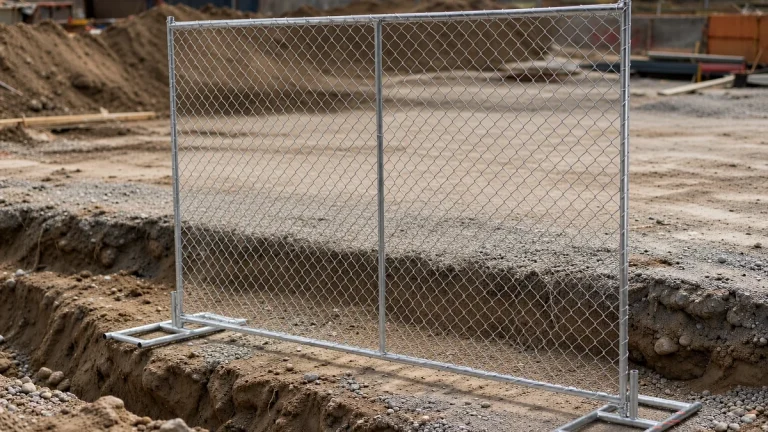
| US construction excavations | OSHA 1926.501(b)(7)(ii) requires fall protection at wells, pits, shafts and similar excavations 6 ft or more deep. Paragraph (b)(7)(i) addresses excavation edges obscured by vegetation or another visual barrier. 1926.501 | Do not substitute an ordinary site panel for a suitable fall-protection arrangement. |
| Excavation work in Victoria | WorkSafe’s excavation compliance code addresses edge protection as part of controlling falls into excavations. ISBN excavation compliance code 2018 05.pdf | Use the applicable excavation controls rather than selecting a boundary panel by price alone. |
| Licensed dog boarding in England | Guidance specifies minimum 2 mm wire where dogs access mesh, square mesh no larger than 50 × 50 mm, and chain link no larger than 75 × 50 mm, with openings that prevent entrapment. Dog kennel boarding licensing statutory guidance for local authorities | Check species, mesh geometry, height, gaps and escape prevention; construction fencing is not automatically kennel fencing. |
| Poultry predator exclusion | University guidance describes buried and outward-turned perimeter wire: UMD gives at least 1 ft down plus 8–10 in outward; the Penn State resource gives at least 12 in down plus about 6 in outward. Identifying and preventing poultry predators mid atlantic region fs 1132 Small scale poultry housing | A freestanding panel alone lacks a buried anti-dig barrier. Assess the complete enclosure, including ground protection and roof. |
These are different jurisdictions and applications, not interchangeable worldwide specifications. None of these cited passages establishes a blanket prohibition on second-hand panels.
OSHA also requires frequent and regular inspections by employer-designated competent persons and prohibits use of equipment that fails applicable requirements. 1926.20 HSE’s excavation guidance calls for substantial barriers where people may fall and inspection by a competent person at the start of each shift. Excavations.htm A seller’s assurance does not replace those responsibilities.
Standards and records
Where a project specifies AS 4687.2:2022, establish how the proposed system meets its design, installation and performance requirements for temporary fencing and pedestrian barriers. As 4687 2 2022 A generic product description is not evidence of conformance.
For US road work, distinguish site fencing from traffic control devices. The MUTCD framework in 23 CFR 655.603 applies to traffic control devices on roads open to public travel and includes requirements for Federal-aid construction projects. Section 655.603 An ordinary fence panel is not automatically a traffic barrier or vehicle-restraint system.
If inspection documents under BS EN 10204 are required, check that the documents match the supplied products and satisfy the contract. BSI’s public overview includes transmission of inspection documents by an intermediary; resale alone is not grounds to claim that all documents become invalid. Missing identification or broken traceability must be resolved with the supplier and project reviewer. Metallic products types of inspection documents
Inspect the lot before payment
Arrange safe access to individual panels rather than judging only the top of a stack. Inspect clean, dry surfaces in adequate light, and have the seller handle or unstack panels safely. Do not stand an unsupported panel upright to test whether it rocks.
| Item | Check before accepting | Hold or reject when |
|---|---|---|
| Frame and welds | Model, straightness, dents, weld condition and repair history | Cracks, broken joints, kinks or unexplained structural repairs need assessment |
| Mesh | Broken wires, sharp ends, detached welds and opening dimensions | Damage creates an escape, access or injury risk |
| Coating and steel | Rust, pitting, flaking, exposed steel and inaccessible corrosion sites | Section loss or coating condition cannot be adequately assessed |
| Feet and connections | Socket fit, bolts, threads, clamps, braces and compatibility | Parts are cracked, badly worn, mismatched or unavailable |
| Dimensions | Actual height, width, tube dimensions and fit to the planned run | Sizes differ from the agreed specification |
| Completeness | Count panels, feet, connectors, gates and support equipment separately | Missing parts erase the saving or prevent the specified installation |
| Identification and records | Manufacturer, model, instructions, inspection history and relevant documents | Required evidence cannot be linked to the equipment |
This is a purchasing screen, not a structural certification. Local coating damage may be repairable; it is not the same as a cracked weld or substantial steel loss. White deposits alone do not establish remaining zinc thickness, and paint can conceal damage. Ask for the manufacturer’s acceptance and repair criteria when available.
ISO 1461:2022 concerns hot-dip galvanized coatings on fabricated iron and steel articles; its public scope excludes continuously galvanized wire and welded mesh products, among other categories. Confirm the manufacturing process before specifying it. 81435 ISO 12944-2 classifies environments for protective paint systems, but an environment category alone cannot establish a used panel’s remaining life. 64834 ASTM A780/A780M is titled “Standard Practice for Repair of Damaged and Uncoated Areas of Hot-Dip Galvanized Coatings”; it is not a certification of frame strength. A0780_a0780m 20
Record accepted panels, repairs and rejected items before loading. Ask about vehicle impacts, fire, salt exposure and previous modifications. Put the price basis, rejection criteria and responsibility for removing rejects in writing. Our guide to tracking fence panels across rental jobs describes permanent IDs and movement records; creating a new register helps future inspections but cannot recreate missing historical evidence.
What our own specifications reveal
Haisen supplies new fencing, so we have a commercial interest in that comparison. Our contribution here is our published product specification and cost method, not a field trial of second-hand lots. Our company information identifies Hebei Haisen Fence Products Co., Ltd. and its factory in Raoyang County, Hebei, China.
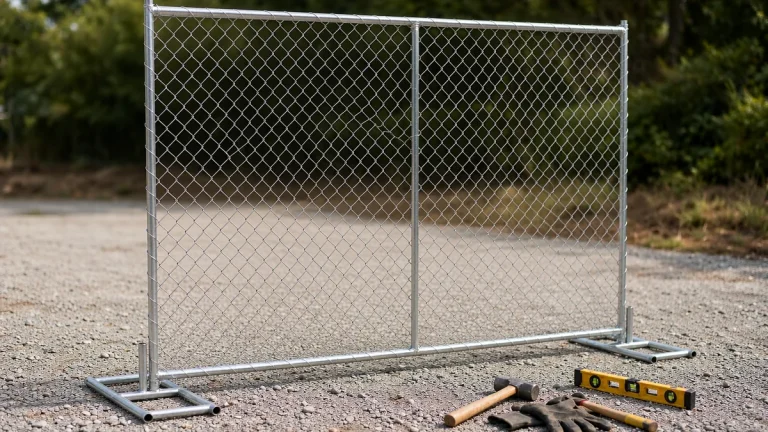
Our temporary fence product page lists 6 × 8, 6 × 9.5 and 6 × 10 ft panels; 3.0, 3.5 and 3.8 mm wire; 25 × 25 or 30 × 30 mm outer frames; and hot-dip galvanized or powder-coated finishes. Those options show why “a six-foot panel” is not enough information for a like-for-like purchase. Frame wall thickness, connection details and the selected coating still need confirmation.
The listed mesh options are 50 × 100, 50 × 150, 50 × 200, 75 × 100 and 75 × 150 mm. For example, a 50 × 200 mm opening has a long dimension four times 50 mm. Neither cleaning nor a new coating turns it into 50 × 50 mm mesh. Do not assume it satisfies the English dog-boarding guidance, or that supervision removes an entrapment risk.
Our product page does not state a project-specific wind-load rating. It calls for review of wind exposure, screening, fence length, feet, ballast, anchoring and bracing for the installation site. This limitation applies to a new purchase too. WorkSafe Victoria specifically notes that signage and shade-cloth coverings may require additional support against wind loads. Construction site security fencing
Put the same questions to both sellers
Our published quotation checklist asks for application, run length, panel dimensions, wire and mesh, frame and rail details, finish, feet, connectors, gates, screening, quantity, packing and delivery terms. Use the same list with a used-lot seller. Request photographs and measurements for the actual stock, a count of included components, and records supporting any claimed performance.
For the new option, request an itemized specification and quotation rather than assuming every accessory or document is included. Our installation planning guide helps define layout, connections and ground conditions before comparing offers.
The buying decision
Buy used when you can verify suitability, inspect the stock and retain a worthwhile saving after missing parts, rejects, delivery and preparation. In our stated example, that is $9.37 versus a $16.53 benchmark per usable foot; three hours of labour per purchased panel would raise the used figure to $18.14 and erase the advantage.
Choose a documented new or hire system when the used lot cannot meet the specification, arrives too late after repairs, or lacks evidence the project needs. For safety-critical applications, have the responsible competent person assess the complete installation. The deciding factor is verified suitability at the full project cost—not whether the steel has had a previous owner.
Need a new-panel quotation to compare with a used lot? Send Haisen the panel specification, component quantities, intended use and delivery destination. Include any required performance documents.
Sources
Sources reviewed on 26 October 2026. Regulatory guidance applies to the jurisdictions stated above. Standards references use public titles and scope information, not unpublished test results or certification claims.
- HSE — Temporary works
- HSE — Protecting the public
- WorkSafe Victoria — Construction site security fencing
- OSHA — 29 CFR 1926.501, Duty to have fall protection
- WorkSafe Victoria — Excavation compliance code
- DEFRA — Dog kennel boarding licensing guidance for England
- University of Maryland Extension — Identifying and preventing poultry predators
- Poultry Extension — Small-scale poultry housing, Penn State resource
- OSHA — 29 CFR 1926.20, General safety and health provisions
- HSE — Excavations
- Standards Australia — AS 4687.2:2022, Temporary fencing and hoardings, Part 2
- eCFR — 23 CFR 655.603, Standards
- BSI — BS EN 10204:2004, Metallic products: Types of inspection documents
- ISO — ISO 1461:2022, Hot dip galvanized coatings on fabricated iron and steel articles
- ISO — ISO 12944-2:2017, Classification of environments
- ASTM International — A780/A780M-20, Repair of damaged and uncoated areas of hot-dip galvanized coatings