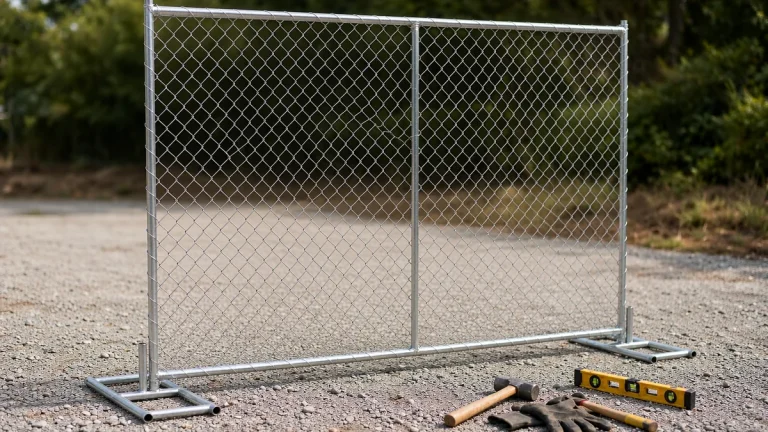
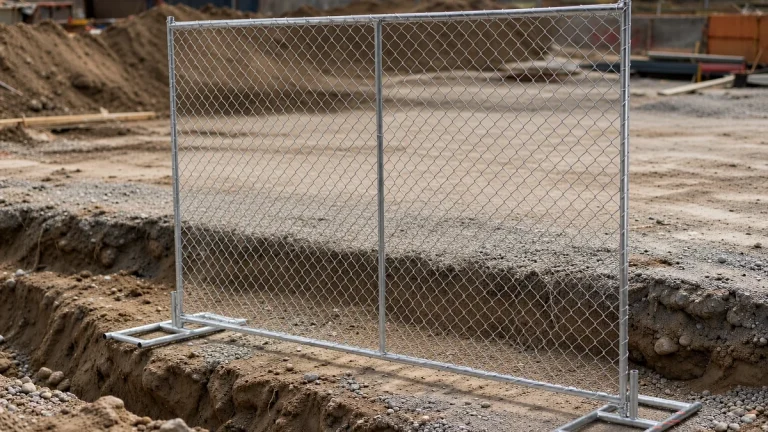
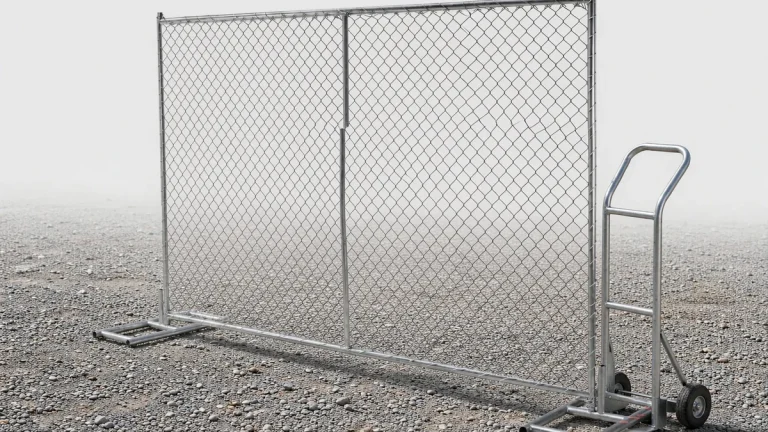
Remove fresh concrete splashes promptly with water and a nylon brush. For hardened deposits, support the panel, start with gentle hand cleaning on a small area, and stop if the wire, welds or coating begin to suffer. Concrete locked around a foot or anchor needs a separate removal decision: secure the fence first, then assess whether cleaning or replacing the affected component makes sense. Do not use muriatic acid on galvanized panels; it aggressively attacks the zinc coating [1].
The aim is a usable fence panel, not bare metal at any cost. A deposit that cannot be removed without damaging the panel may be a reason to replace the component rather than use a more aggressive tool.
Choose the method by the deposit, not the clock
There is no reliable universal “45-minute wash-off” or “six-hour scraping” window for concrete on a fence. Cement setting tests do not establish a cleaning timetable. NIST research explains that even Vicat initial- and final-set results are insufficient to establish some practical working periods, such as pumping or extrusion [2].
For cleaning, check whether the deposit actually rinses away or releases under gentle hand pressure. Age is useful background information, but a wet sheen, a tapping sound or the number of hours since the pour is not a strength test.
| What you find | First approach | When to stop or change the plan |
|---|---|---|
| Fresh, loose splashes on mesh or frame | Contain runoff; rinse and use a nylon brush | The deposit no longer washes away readily |
| Stiff residue that releases under gentle hand pressure | Try a plastic scraper on a small, accessible area | The finish scratches, wire moves or the residue remains firmly bonded |
| Hardened concrete wrapped around wires or welds | Isolate and support the panel; have the removal method assessed | Removal would cut wires, break welds or strip substantial coating |
| Concrete inside a detachable foot or around a spigot | Support the panel independently and inspect the fitting | The fitting is jammed, distorted or inaccessible; consider replacement |
| A footing, ballast block or slab anchor supporting the fence | Establish replacement support before disturbing it | The support or anchoring arrangement is unknown |
Secure the panel and identify its finish
Before disconnecting clamps or removing a foot, maintain the site boundary with a suitable replacement barrier. Support the affected panel so neither its weight nor the attached concrete is carried by the fitting being released. Do not assume a concrete lump is harmless ballast or that a thin-looking deposit is light enough to handle alone.
Check feet, clamps, braces, gates, ground conditions and any screens before changing the fence line. UK HSE guidance requires temporary works to be planned and managed for foreseeable loads; it is not a source of a universal ballast weight for every fence [3]. Haisen’s guide to planning a temporary fence installation helps identify the components that need checking together.
Confirm whether the panel is hot-dip galvanized, powder coated or has a coating system over galvanized steel. The finish determines which cleaning and repair instructions apply. Haisen’s listed temporary fence panels include galvanized and powder-coated options, with wire diameters of 3.0, 3.5 or 3.8 mm. Those product dimensions do not establish a safe impact force, grinder clearance or wind rating.
Prepare a water supply, nylon brush, plastic scraper, runoff containment and suitable handling supports. Select eye protection, gloves, footwear and other protective equipment for the actual splash, handling and tool hazards. Fresh cement paste is strongly alkaline and can chemically burn skin, so avoid direct contact with wet concrete and contaminated wash water [4].
Wash off fresh concrete before it bonds firmly
Work in a designated cleaning area where water and solids can be collected. Start with an ordinary hose rinse and a nylon brush, keeping slurry out of open frame tubes and foot sockets. Clean both accessible sides rather than pushing residue through the mesh and leaving it on the back.
Use a plastic scraper only where residue releases without forcing the tool into the finish. Rinse loosened material away, collect the solids and inspect the surface again. If the deposit resists gentle cleaning, treat it as a bonded deposit rather than increasing pressure indefinitely.
The American Galvanizers Association recommends water and, when needed, a nylon bristle brush for ordinary dirt on galvanized steel. Its pressure-washing guidance is below 1,450 psi; this is coating-care guidance, not proof that a pressure washer will remove hardened concrete or that every panel finish tolerates that pressure [1].
Use the panel or coating supplier’s lower limit where one is specified. Collect wash water for disposal under the site’s waste arrangements; do not direct cement slurry into drains or neighboring soil.
Remove hardened deposits without sacrificing the panel
Start with a small, accessible area
With the panel securely supported, try gentle hand cleaning at an exposed edge of the deposit. Keep the scraper off welds and avoid using a mesh wire as a lever point. Inspect the cleaned patch before continuing: look for displaced wires, lifted coating and exposed steel.
For galvanized surfaces, the Galvanizers Association of Australia recommends a hard plastic bristle brush where mechanical abrasion is necessary and warns against continual abrasive cleaning [5]. This does not validate powered brushing, chiseling or grinding as coating-safe concrete-removal methods.
Stop when the concrete is locked around a wire, the mesh flexes under the tool, or the finish comes away with the residue. A manufacturer or qualified repair contractor should assess whether controlled removal is feasible and how any resulting coating damage would be repaired.
Do not transfer bridge-demolition methods to welded mesh
Large breakers, planers and shot-blasting machines are not a default cleaning kit for fence panels. The SHRP concrete-removal report concerns bridge rehabilitation; its shot-blasting equipment is restricted to horizontal surfaces by the collection chamber needed to contain rebounding shot [6].
That report does not establish a safe hammer weight for thin fence wire, a removal rate for a coated panel, or a routine sequence of chipping followed by grinding. Do not grind between mesh wires simply because a wheel appears to fit. If a contractor proposes powered removal, require a method suited to the panel and finish, with support, tool access, dust control and repair addressed before work starts.
Control concrete dust if powered work is necessary
For US construction work, OSHA’s silica standard allows either full implementation of the applicable Table 1 controls or the alternative exposure-control requirements. Table 1 includes water delivery or shrouded dust collection for specified powered chipping tasks; respiratory protection also depends on the task, duration and whether work is indoors or enclosed [7].
A hose beside the work or an ordinary shop vacuum is not, by itself, evidence that those requirements are met. Use the correct task-specific arrangement and equipment instructions. Do not add water to a tool that is not designed for wet operation.
Collect debris and slurry before they become a dust source. OSHA restricts dry sweeping and dry brushing where they could contribute to silica exposure unless lower-exposure alternatives are not feasible; it also restricts compressed-air cleaning [7]. Outside US construction, apply the rules governing the workplace and activity concerned.
Deal with concrete in feet, sockets and anchors separately
Detachable feet and blocked sockets
A detachable design does not mean a concrete-filled fitting can be pulled apart safely. First support the panel independently. Remove only accessible loose material and check whether the connection releases without force. Do not twist the panel or hammer the frame to free a jammed spigot.
If concrete remains bonded inside the fitting, compare replacement with specialist removal. Frame-tube dimensions are not socket-clearance dimensions, so identify the actual foot, spigot and connection before ordering parts. A bent socket or cracked base should be kept out of service pending assessment.
Cast footings and slab anchors
A footing, ballast block and slab anchor perform different jobs. Do not break away concrete that may be providing support until the site’s responsible person has specified how the fence will remain stable.
Whether an anchor can be unbolted, removed, cut flush or left in place depends on its type, the substrate and the site requirements. There is no general rule that all anchors must remain or that all footings should be broken out. Excavation or slab demolition needs its own plan, including utility checks and protection of the surrounding structure.
Avoid acid damage and match repairs to the coating
Do not use muriatic acid as a shortcut on galvanized fencing. Muriatic acid is hydrochloric acid, and the American Galvanizers Association warns that it and other strong acids aggressively attack galvanizing [1].
A proprietary concrete remover is not automatically compatible with zinc, powder coating or a combined coating system. Use one only when both the remover instructions and the panel or coating supplier confirm compatibility with the actual finish. Follow the safety data sheet, rinsing and disposal instructions. Without that confirmation, do not experiment across a whole panel.
After cleaning, inspect for coating loss and corrosion. ASTM A780/A780M concerns repair of damaged hot-dip galvanized coatings; it is not a general powder-coating repair standard [8]. Powder-coated panels need a repair system specified for their coating and substrate. Painting over a crack or broken weld does not restore the panel’s structural condition.
Decide whether the cleaned panel can return to service
Inspect both faces, the underside of the frame and every connection that was covered by concrete. Separate and label components needing repair rather than mixing them into usable stock. Haisen’s storage and transport guidance calls for structural damage to be assessed by the manufacturer or a qualified person before reuse.
- Frame and welds: no unresolved distortion, cracks or broken welds.
- Mesh: no broken wires, sharp projections or enlarged gaps created during removal.
- Finish: damage identified and repaired with the specified coating system.
- Feet and connections: sockets, threads, clamps and bases checked for damage and correct fit.
- Installation: support, ballast, bracing and anchoring checked against the current site plan.
Where the panel forms part of an animal enclosure, move animals to secure alternative containment before opening the boundary. Remove fragments, slurry and sharp debris before returning them. Recheck ground-level gaps, doors and latches for the species housed; a construction fence panel is not automatically a suitable animal enclosure.
How long does cleaning take, and when is replacement better?
There is no verified per-panel cleaning time for this guide. Bridge-deck production rates cannot predict how long it takes to clean thin coated wire, restricted sockets or irregular concrete splashes.
For a useful estimate, have the person doing the work assess one representative panel. Record the deposit coverage, access, cleaning time, coating damage and repairs needed. Include handling, containment, cleanup and replacement parts when comparing the result with a new panel or foot. The panel price guide identifies the specifications needed for a comparable replacement quote.
This guide is based on published coating-care guidance, workplace requirements and Haisen’s product information, not a firsthand removal trial. A small-area assessment is a proposed check for your job, not a reported test result. Documenting that check gives you evidence for the next cleaning decision without assuming every deposit behaves alike.
Keep concrete off the next panel
Plan the fence position and concrete work together while maintaining the required site boundary. Keep mixing and washout away from the fence where practical, protect vulnerable fittings from splashes, and arrange prompt cleaning after nearby pours.
Do not attach broad sheeting to a standing fence without checking its effect on wind loading. Likewise, do not relocate feet or reduce ballast merely to make cleaning easier. Preventing the next deposit is useful only if the fence still does its job.
Need replacement panels or compatible feet? Send Haisen the panel dimensions, wire diameter, mesh opening, finish, quantity and delivery destination. For a replacement fitting, include its measurements and connection details so compatibility can be checked.
Sources
- American Galvanizers Association, Cleaning Hot-Dip Galvanized Steel — https://galvanizeit.org/knowledgebase/article/cleaning-hot-dip-galvanized-steel. Accessed 25 October 2026.
- National Institute of Standards and Technology, New Approach to Identify Compatibility of Materials for Concrete Related to Early Stiffening — https://www.nist.gov/publications/new-approach-identify-compatibility-materials-concrete-related-early-stiffening. Published 13 September 2006; accessed 25 October 2026.
- Health and Safety Executive, Temporary works — https://www.hse.gov.uk/construction/safetytopics/temporary-works.htm. UK construction guidance; accessed 25 October 2026.
- Federal Highway Administration, Petrographic Manual, Chapter 10, Alkali-Aggregate Reactions — https://www.fhwa.dot.gov/publications/research/infrastructure/pavements/pccp/97146/chaptr10.cfm. Accessed 25 October 2026.
- Galvanizers Association of Australia, Maintenance and Cleaning Galvanized Steel — https://gaa.com.au/maintenance-and-cleaning-galvanized-steel/. Accessed 25 October 2026.
- Transportation Research Board, Techniques for Concrete Removal and Bar Cleaning on Bridge Rehabilitation, SHRP S-336, section 2.3 — https://trb.org/publications/shrp/shrp-s-336.pdf. Bridge-rehabilitation scope, not a fence-panel procedure; accessed 25 October 2026.
- OSHA, 29 CFR 1926.1153, Respirable crystalline silica, paragraphs (c), (d) and (f) — https://www.ecfr.gov/current/title-29/subtitle-B/chapter-XVII/part-1926/subpart-Z/section-1926.1153. US construction; versioned regulatory text checked on 25 October 2026.
- ASTM A780/A780M-20, Standard Practice for Repair of Damaged and Uncoated Areas of Hot-Dip Galvanized Coatings — https://www.astm.org/a0780_a0780m-20.html. Scope checked 25 October 2026; applies to hot-dip galvanizing, not general powder-coating repairs.