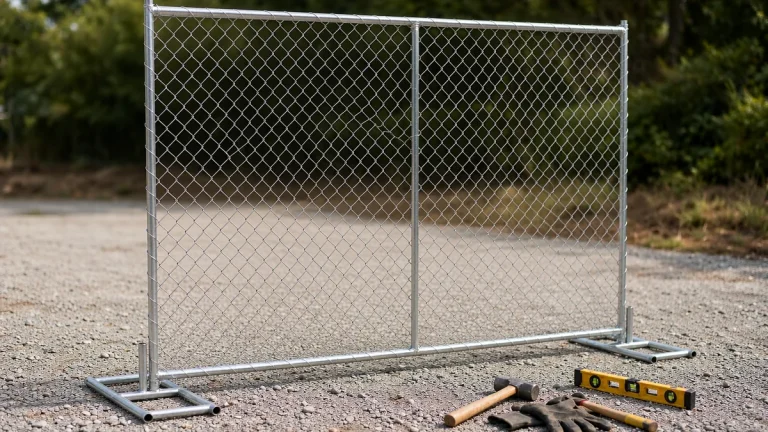
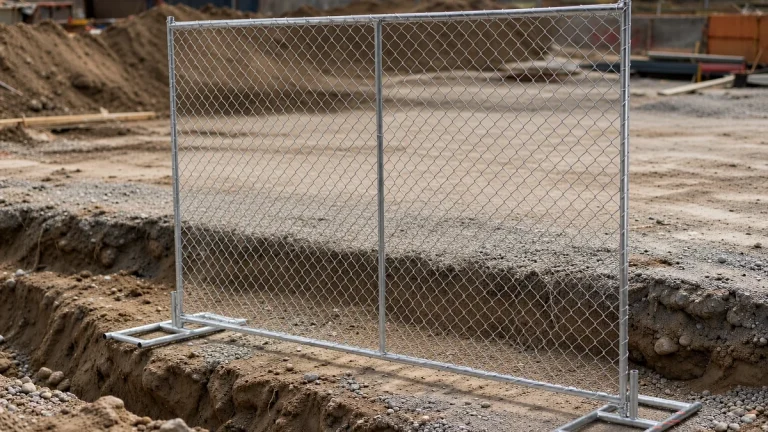
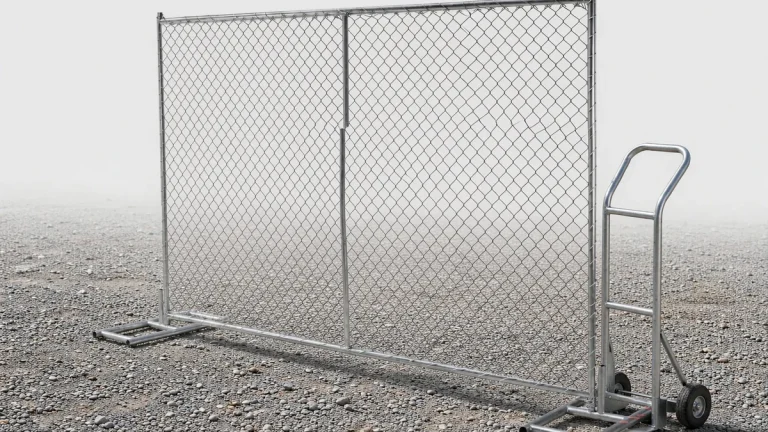
Temporary fencing can suit a pool construction site, but ordinary portable site panels should not be assumed to qualify as the pool’s safety barrier. A purpose-built removable pool fence is a different product: it may be suitable when its design, gate, installation and use meet the applicable local requirements. CPSC’s residential guidance specifically discusses removable mesh pool fences, so “removable” does not automatically mean unsuitable 362%20Safety%20Barrier%20Guidelines%20for%20Pools.pdf.
For Haisen’s standard temporary panels, the published specifications do not establish pool-barrier compliance. Nominal height alone cannot settle the question. Openings, climbability, ground clearance, gate operation and resistance to displacement must be assessed as one installed system.
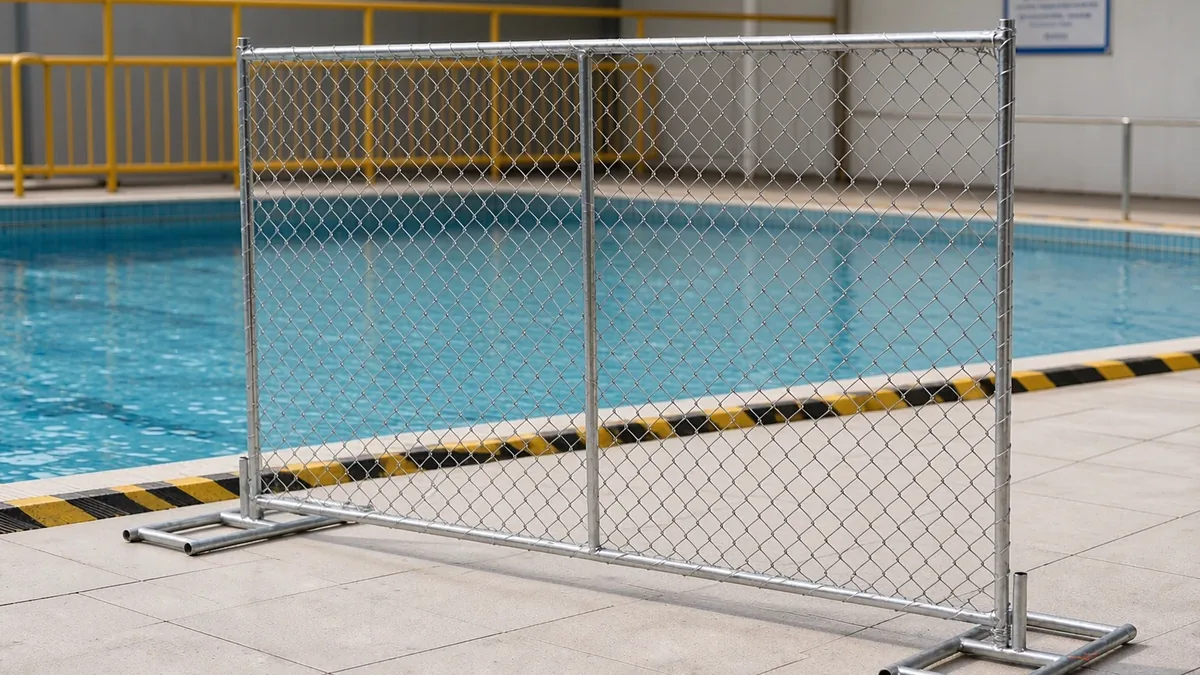
During construction or repairs, use site fencing for work-area access control under the site’s applicable requirements. An empty pool still presents an excavation or fall hazard. If water remains in the pool, maintain its compliant barrier; closing the pool for maintenance does not make a portable exclusion line an equivalent replacement.
Which kind of temporary fence do you mean?
| Fence type | Appropriate role | What determines suitability? |
|---|---|---|
| Portable construction panels on detachable feet | Separating a work area and directing access | Site conditions, connections, supports and construction requirements. A product description or nominal height does not establish pool-barrier compliance. |
| Purpose-built removable mesh pool fence | A potential pool barrier | The applicable pool code, complete system specification, gate, installation and required approvals. CPSC refers readers to ASTM F2286 for removable mesh fencing. |
| Temporary panels outside an existing compliant pool barrier | Additional work-area separation | The extra line must not compromise the existing barrier, create climbing access or obstruct emergency routes. |
CPSC recommends locating barriers so that structures and equipment cannot be used to climb them. Its removable-mesh guidance also addresses height, post spacing, anchorage and bottom clearance—not simply whether the fence can be taken down 362%20Safety%20Barrier%20Guidelines%20for%20Pools.pdf.
The distinction matters because drowning is the leading cause of death for children ages 1–4 in the United States, according to CDC. Its cited 2018–2021 data show an annual average of 4,345 unintentional drowning deaths across all ages; that figure is not limited to children or swimming pools Index.
What should a pool barrier provide?
The following measurements summarize US CPSC residential guidance. They are not a universal building code: CPSC explicitly says the guidelines are neither a CPSC standard nor mandatory requirements. Confirm the governing rules for your location and pool type before choosing a system 362%20Safety%20Barrier%20Guidelines%20for%20Pools.pdf.
| Feature | CPSC guidance | Why it matters for portable panels |
|---|---|---|
| Height | At least 48 in (1,219 mm), measured from the side facing away from the pool; 5 ft or higher is preferable. | Measure installed height above outside grade, rather than relying on the panel’s nominal size. |
| Openings | Openings should not allow a 4 in (101.6 mm) diameter sphere to pass. | Check mesh, joints, corners, gates and gaps beneath the line. |
| Horizontal and vertical members | With horizontal-member tops less than 45 in apart, put horizontal members on the pool side and limit vertical-member spacing to 1¾ in (44.45 mm). The guide describes a 4 in vertical-spacing allowance for wider horizontal-member separation; decorative cutouts remain limited to 1¾ in. | A middle rail and welded mesh need assessment for climbing access, not just the sphere test. |
| Chain link | Maximum mesh size of 1¼ in square, unless secured slats reduce openings to no more than 1¾ in. | Do not substitute a welded-mesh aperture specification for a chain-link specification. |
| Bottom clearance | Maximum 4 in; reduce to 2 in over grass or pebbles and 1 in for removable mesh fencing. | Feet, uneven ground and slopes can create larger gaps. |
| Pedestrian gate | Opens away from the pool, self-closes, self-latches and has a locking device. | A supplied hinge and latch do not establish automatic closing and latching. |
| Low latch release | If the release mechanism is less than 54 in from the bottom of the gate, place it on the pool side at least 3 in below the gate top, with no opening greater than ½ in within 18 in of the release. | The trigger is the release mechanism’s height, not the gate’s overall height. |
| Removable mesh fencing | At least 48 in high; support posts no more than 40 in apart and extending at least 3 in below grade; bottom no more than 1 in above the deck or installed surface. | These details describe a purpose-built pool-fence system, not loose construction panels. |
These are selected recommendations, not a complete compliance checklist. The CPSC publication also covers walls, diagonal members, house access and above-ground pools. Its Figure 4 labels the horizontal-member separation as “45 inches or more,” while the accompanying prose says “more than 45 inches”; use the governing local code to resolve the exact threshold for a proposed installation 362%20Safety%20Barrier%20Guidelines%20for%20Pools.pdf.
Why do local rules change the answer?
Texas provides an example of rules that differ from the residential guidance. Under 25 TAC §265.192(b), Class A and B pool enclosures require at least 6 ft of effective perpendicular height measured from outside, no horizontal mid-rail and no opening that admits a 4 in sphere. The section permits chain-link mesh up to 1¾ in. Gates must open outward and be lockable; during operation, doors and gates must be continuously supervised or locked against unauthorized entry 25 Tex Admin Code SS 265 192.
Texas Class C and day-camp pools not subject to Health and Safety Code Chapter 757 have separate provisions in subsection (d), including a 48 in minimum height. For horizontal-and-vertical-member enclosures built or replaced on or after January 1, 2021, no horizontal mid-rail is allowed. The chain-link prohibition covers Class C pools built on or after October 1, 1999, and replacement chain-link fences at older Class C pools. Subsection (c) instead directs covered multiunit-rental and property-owners-association pools to Chapter 757 25 Tex Admin Code SS 265 192.
Arizona’s §36-1681 illustrates another framework: its main enclosure provision specifies at least 5 ft, measured on the exterior side, and at least 20 in between the barrier and water’s edge. However, the statute has scope limits, alternatives where a residence forms part of the enclosure, and exemptions. Its starting definition concerns water at least 18 in deep and wider than 8 ft that is intended for swimming. Do not apply its headline height requirement without checking the full section and the local ordinance 01681.htm.
Ask the building or pool authority which rules cover your address, pool classification and construction stage. An HOA’s approval does not substitute for the responsible authority’s requirements. Outside the United States, check the relevant national and local rules rather than applying these US examples.
How do Haisen’s temporary panels compare?
Our temporary fence product page lists a nominal 6 ft height, detachable feet, welded mesh and a middle horizontal pipe. The comparison below uses those published specifications. It is a supplier’s specification review, not an independent test report or a claim of pool-barrier certification; the public material reviewed does not establish that certification.
| Item | Published specification | Assessment |
|---|---|---|
| Height | 6 ft nominal, approximately 1.83 m | Could meet a height criterion if the installed effective height is sufficient. Meeting a 48 in requirement does not require an exact 72 in installation. |
| Mesh openings | 50 × 100, 50 × 150, 50 × 200, 75 × 100 or 75 × 150 mm | Each listed aperture has a short dimension below 101.6 mm, so its stated geometry would exclude a rigid 4 in sphere. This does not verify joints, deformation or the complete installed barrier. |
| Vertical spacing and climbing | Smallest listed aperture dimension: 50 mm. Middle pipe: 20 × 20 or 25 × 25 mm. | Even 50 mm exceeds 44.45 mm where the 1¾ in spacing limit applies. The middle rail conflicts with the Texas no-mid-rail provisions described above. Other jurisdictions require their own assessment. |
| Ground clearance and retention | Detachable feet; installed geometry depends on the base and site | Unverified from the product listing. Measure every gap and establish how panels are secured against lifting and displacement. |
| Gate | The separately listed chain-link fence gate describes hinges and a latch, without published self-closing or self-latching performance. | Unverified—not proof of a failed test. Confirm compatibility and automatic operation of the complete gate assembly. |
| Stability | No project-specific wind-load rating is stated. | A site-specific support plan is needed. Neither a heavy foot nor the word “temporary” establishes stability. |
There are two different checks here: keeping a child from passing through an opening and limiting footholds for climbing. Passing the first does not establish the second. For example, a 50 mm opening is about 1.97 in—smaller than a 4 in sphere but larger than the 1¾ in spacing limit. Our mesh opening and wire gauge guide explains why opening size and wire thickness must be specified separately.
The separate chain-link temporary fence listing offers 4, 6 and 8 ft heights and 10–14 ft lengths, with mesh and wire details confirmed per order. Do not transfer the welded-panel measurements to that product.
What our published product and handling guidance shows
Specify the actual opening and wire diameter
Our welded wire fencing page asks buyers to state both mesh dimensions and the actual wire diameter, rather than treating a BWG reference as a complete diameter specification. For a pool-related enquiry, that means requesting the proposed panel drawing and its orientation before comparing vertical spacing with a rule. A thicker wire does not resolve an opening that is too large.
Separate published inspection guidance from proof of compliance
The fence post page describes checking production against an approved drawing, specification, sample, purchase order and packing requirements. That is a published quality-review framework for the stated product, not evidence that a temporary panel has passed pool-barrier testing. For a proposed pool installation, request documentation for the actual system and its gate rather than relying on a different product’s inspection description.
Count serviceable panels, not just stored panels
Our storage and transport guide recommends checking frames, welds, mesh, coating, connections and bases before reuse. Its illustrative inventory calculation is 100 panels minus 8 awaiting repair and 2 withdrawn from use, leaving 90 available. This is a planning example, not a reported customer result or an actual stock count.
The same guide notes that touch-up paint cannot repair a cracked weld or replace metal lost to corrosion. Keep damaged equipment out of the usable count until it has been assessed. These observations come from our published product and handling guidance; they are not a claimed pool installation, field trial or independent performance study.
How should temporary fencing be used during pool work?
Construction and drained repairs
Use an exclusion line to manage access to the work area while retaining whatever protection the excavation and site require. Our construction-site fencing guide distinguishes perimeter panels from fall-protection guardrails and vehicle-impact barriers. A drained pool is not automatically a safe area, and a portable fence is not a substitute for the required protection at a drop.
Maintenance while water remains
Keep the compliant pool enclosure in service and control access through it. Temporary panels can separate equipment or a repair area outside that enclosure, provided they do not create climbing aids or block access. Texas’s cited Class A/B provisions explicitly require gates to be locked when pools are closed for repairs, hazards or manual chemical addition 25 Tex Admin Code SS 265 192.
Connections, supports and clearance
Review the entire line: feet, clamps, braces, ballast, anchors and gates. Our installation planning guide explains that some panels can lift out of their feet even when adjacent frames are clamped, and that there is no universal brace-spacing rule. Screening and signs change wind exposure; support requirements must reflect the actual installation.
Keep feet, braces and open gates out of walkways and emergency routes. Check the ground beneath each base and the gaps between supports, especially on slopes. For reused equipment, confirm the coating specification and repair requirements using the galvanized versus powder-coated panel guide; a finish description is not a guaranteed service life beside a pool. Have a qualified electrician assess any bonding or grounding implications of metal fencing near pool equipment.
What should you install as the pool’s barrier?
Choose a complete pool-barrier system that meets local requirements: a suitable permanent fence or wall, or a purpose-built removable pool fence where permitted. CPSC discusses removable mesh fences with reference to ASTM F2286 and power safety covers with reference to ASTM F1346. Naming either standard is not proof that a particular product complies; obtain the relevant product documentation and confirm which edition and installation requirements apply 362%20Safety%20Barrier%20Guidelines%20for%20Pools.pdf.
If the house forms part of the enclosure, review the permitted protection for doors and windows. The CPSC guidance describes alternatives including door alarms, a compliant power safety cover or other protection offering an equivalent degree of safety. It does not establish a universal right to replace a required fence with a cover 362%20Safety%20Barrier%20Guidelines%20for%20Pools.pdf.
For an above-ground pool, the structure may form part of the barrier when suitable. CPSC describes securing, locking or removing the ladder or steps, or enclosing them with a barrier. Any opening created when access equipment is secured or removed should not admit a 4 in sphere 362%20Safety%20Barrier%20Guidelines%20for%20Pools.pdf.
A barrier remains one layer of protection. CDC recommends a four-sided fence separating the pool from the house, with self-closing and self-latching gates, alongside close supervision, swimming skills and other drowning-prevention measures Index.
How many panels do you need, and what affects cost?
For a construction exclusion line, divide the planned run by the panel’s effective installed width and round up, then account for gates, corners and connection allowances. As a preliminary example, 100 ft divided by a nominal 10 ft panel gives 10 panels. That calculation assumes a straight run and excludes connector allowance, gates, overlap and field adjustments; it is not a final installation schedule.
A nominal 6 × 8 ft panel has 48 sq ft of face area; 6 × 9.5 ft gives 57 sq ft; and 6 × 10 ft gives 60 sq ft. These are height-times-width calculations, not structural ratings. Our panel size guide explains the layout allowances.
Compare quotations on the same scope: panels, feet, connectors, gates, support equipment, packing and freight. Confirm mesh, wire, finish, quantity and destination. The temporary fence quotation guide covers these cost drivers. A site-panel quotation does not establish the price or suitability of a certified pool-barrier system.
What should you confirm before filling or reopening the pool?
- Identify the governing jurisdiction, pool classification and required approval or inspection.
- Confirm that the proposed system is suitable for the pool-barrier role, including its gate and supports.
- Measure effective height from outside grade and check all openings, joints, corners and bottom gaps.
- Review climbing access from rails, equipment, furniture, planters and nearby structures.
- Verify gate swing, self-closing and self-latching operation, locking arrangements and applicable release clearances.
- Check panel retention, anchorage or other supports against the approved installation details; do not treat a casual lift test as certification.
- Resolve electrical, access and emergency-route issues, and obtain any required inspection before filling or reopening.
Frequently asked questions
Is temporary fencing legal around a swimming pool?
That depends on its role and the governing rules. Construction access-control fencing and a pool safety barrier are not interchangeable. Ask the local authority whether the proposed system is acceptable for the specific stage of work; there is no universal exemption simply because the fence is temporary.
Can a removable mesh fence protect a pool containing water?
Potentially, yes, when it is a purpose-built pool-fence system that meets applicable requirements and remains correctly installed. CPSC includes removable mesh fencing in its guidance. This should not be confused with general-purpose panels resting in detachable feet 362%20Safety%20Barrier%20Guidelines%20for%20Pools.pdf.
Does a 6 ft temporary panel automatically meet pool-fence rules?
No. It may satisfy a height requirement, but that does not establish compliant openings, climb resistance, gate operation, ground clearance or stability. The assembled system and the local requirements decide suitability.
How long can temporary fencing stay beside a pool?
Duration alone does not establish safety or compliance. Follow the site’s permit conditions, inspection requirements and installation instructions. Keep the required pool barrier functioning throughout the work, including when the pool is closed to swimmers.
Planning temporary fencing for pool construction?
Send the site layout, run length, gate count, panel specification and delivery destination for a construction-fencing quotation. Identify the pool-barrier requirements separately so the proposed equipment can be reviewed for its intended role.
Request a QuotationReferences
- US Consumer Product Safety Commission. Safety Barrier Guidelines for Residential Pools. Residential safety guidance, not a mandatory CPSC standard. Accessed October 25, 2026.
- Centers for Disease Control and Prevention. Drowning Data. Cited annual-average mortality data cover 2018–2021. Accessed October 25, 2026.
- 25 Tex. Admin. Code §265.192. Pool Yard and Spa Yard Enclosures. Read alongside the Texas DSHS rule text; requirements depend on pool classification. Accessed October 25, 2026.
- Arizona Revised Statutes §36-1681. Pool Enclosures; Requirements; Exceptions; Enforcement. See the full section for scope, alternatives and exemptions. Accessed October 25, 2026.
- Centers for Disease Control and Prevention. Preventing Drowning. Accessed October 25, 2026.