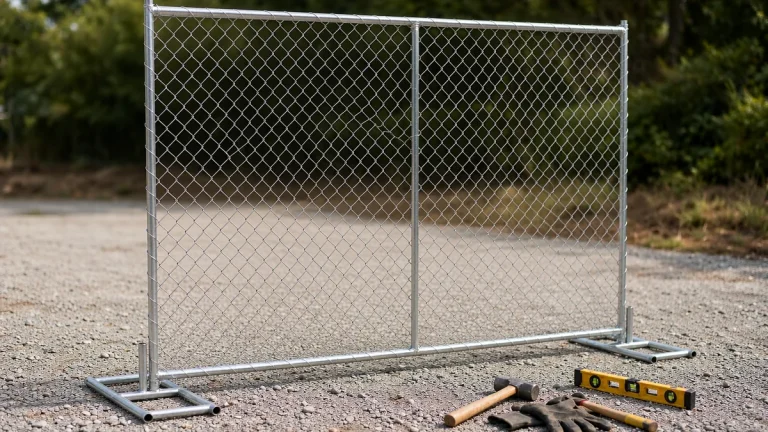
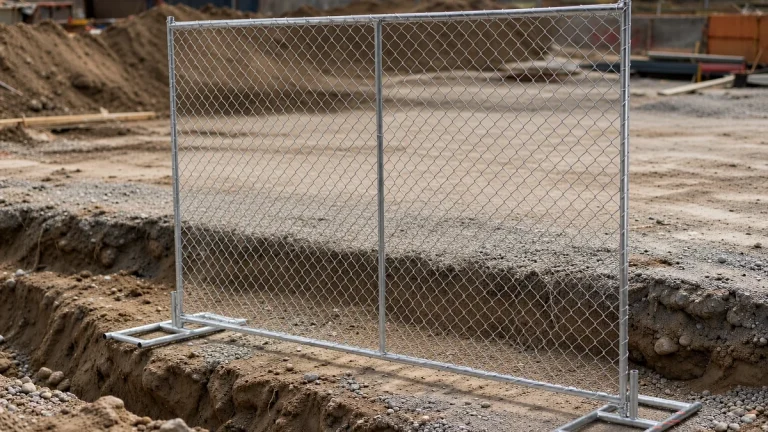
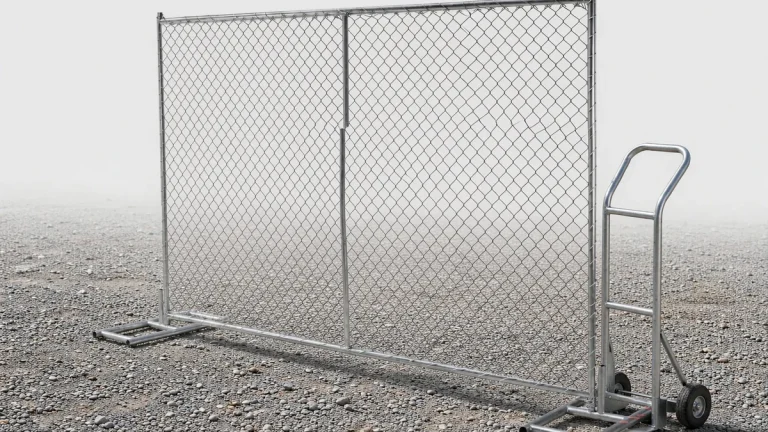
Yes. Temporary fencing can stay up during winter if the installed system is suitable for the site’s expected weather and ground conditions, and someone can inspect and maintain it. Winter does not automatically mean taking it down, but an open-mesh panel is not automatically storm-safe. Unsupported screens, unstable feet, accumulating snow, or damage may require changes, replacement protection, or removal.
This guide covers freestanding welded-mesh fence panels in detachable feet, connected with clamps and supported by the specified braces, ballast, or anchors. It does not assess driven-post fencing or animal enclosures. Confirm the supplier’s installation instructions and applicable local requirements before deciding to leave a fence erected all season.
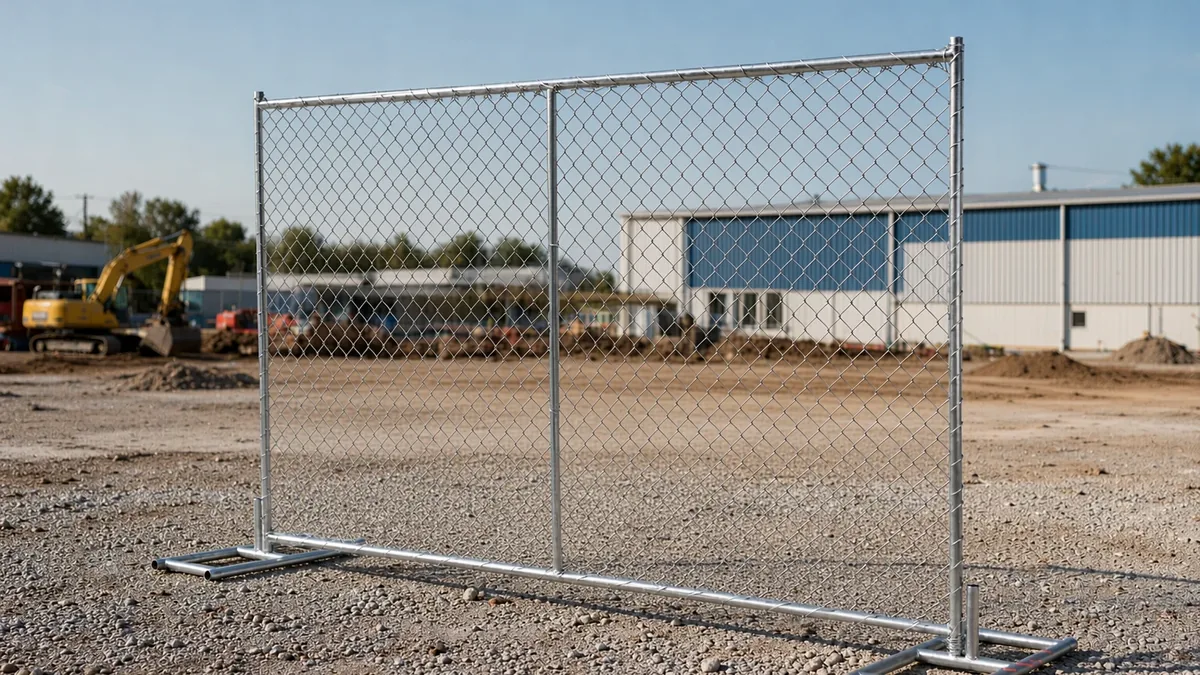
When Can the Fence Stay Up?
| Winter site condition | Decision before leaving it standing |
|---|---|
| Firm, drained ground; sound open-mesh panels; inspections arranged | It may stay up if the complete support arrangement suits the site’s exposure. |
| Exposed location or full-height privacy screens | Obtain setup guidance covering that exposure and screen configuration. Do not assume standard feet are sufficient. |
| Thawing soil, rocking feet, or repeated leaning | Restrict access to the affected area and have the base and supports corrected before continued use. |
| Plow piles, drifting snow, or roof-shedding snow beside the line | Change the snow-management plan or relocate affected sections with suitable replacement protection. |
| Site closed with no inspections available | Arrange monitoring and maintenance, or remove fencing that is no longer needed. Keep required hazard protection in place. |
| Cracked welds, bent frames, failing clamps, or a gate that will not latch | Assess and repair or replace the affected components; do not simply leave them until spring. |
A sheltered location can reduce exposure, but shelter is not a substitute for adequate supports. Conversely, an exposed site is not an automatic rejection if its fence system has been properly specified for the conditions. The decision concerns the installed system, not just the season or the panel material.
Wind, Screens, and Panel Size
There is no single safe wind speed for every temporary fence. Panel dimensions, mesh openness, screens, connections, support spacing, ballast, anchorage, and site exposure all affect the setup. Ask the supplier for the permitted configuration and weather-action limits for the actual fence, including any screen or banner.
For weather context, the U.S. National Weather Service glossary describes a Wind Advisory as generally covering sustained winds of 30 to 39 mph, about 48 to 63 km/h, lasting an hour or longer. This is a weather-advisory definition, not a fence rating or a safe operating limit. Follow local forecasts and the fence’s own action plan rather than waiting for that threshold. [1]
To compare panel sizes in this guide, we calculated the nominal rectangular face areas below. A 6 x 10 ft panel has 25% more gross face area than a 6 x 8 ft panel: (60 – 48) / 48 x 100 = 25%. That calculation does not establish a 25% increase in wind force, a ballast requirement, or a failure speed.
| Nominal panel size | Gross face area | Approximate metric area |
|---|---|---|
| 6 x 8 ft | 48 sq ft | 4.46 sq m |
| 6 x 9.5 ft | 57 sq ft | 5.30 sq m |
| 6 x 10 ft | 60 sq ft | 5.57 sq m |
These figures use nominal height x width and the exact conversion 1 ft = 0.3048 m. They ignore connector overlap and manufacturing tolerances, and include the open spaces in the mesh. They are neither solid material areas nor structural ratings.
Privacy fabric, debris netting, banners, and tarps change wind exposure. Do not add them to a winter fence without confirmation that the whole assembly is suitable. If that confirmation is unavailable, leave them off or arrange an assessed alternative. Do not assume that reducing screen coverage by an arbitrary amount makes the fence safe.
Frozen Ground and Thawing Bases
Check the ground beneath the feet and braces, not just whether the panels look upright. Firm, level pavement or compacted, well-drained gravel may provide a useful base, but neither proves that the fence is adequately restrained. Ice, uneven surfaces, soft fill, and ponding water need attention under the installation plan.
After a thaw, look for a gap beneath a foot, a brace sinking into the ground, shifted ballast, or a change in panel alignment. These are inspection prompts, not a diagnosis of one specific cause. A gate that drags might have ice in its swing path, a hinge problem, or movement in its supports; check before deciding what to adjust.
Use the specified connections and bracing at ends, corners, and gates. Confirm that panels are seated correctly in their feet and that required fasteners are present. Have a trained installer stabilize an affected section before lifting panels, moving ballast, or clearing material from beneath loaded feet. Do not force bent frames into alignment by tightening clamps.
Anchor selection, embedment, and spacing must suit the system and ground conditions. Before driving pins or disturbing the ground, identify buried-service risks. The UK Health and Safety Executive’s HSG47 sets out three basic elements for work near underground services: planning the work, locating and identifying buried services, and safe excavation. These are safety-planning steps, not evidence that an anchor has sufficient holding capacity. [2]
Snow, Ice, and Gate Access
Plan where snow will go before the first clearance operation. Keep plow piles, loader buckets, and roof-shedding snow away from the fence, its feet, braces, and gates. Mark the line where snow could hide it, and tell snow-clearing crews where supports project beyond the panels.
Inspect for snow packed into the lower mesh or against screens. Do not rely on the fence as a retaining barrier for a snow pile. If a bay is leaning or visibly loaded, keep people away and arrange safe clearance and stabilization; do not push it upright or approach it from the side toward which it could fall.
Keep required gate routes clear and check that gates open, close, and latch without being lifted or forced. Avoid striking the coating to remove ice. Follow the supplier’s cleaning and de-icing guidance, and avoid creating new ice hazards with rinse water.
A Practical Winter Inspection Record
Set an inspection schedule appropriate to the site, with additional checks after storms, snow clearance, and thawing conditions, when safe access is possible. An inspection after damage occurs is not a substitute for taking forecast precautions. CDC/NIOSH identifies outdoor workers among those at risk from cold stress, so inspection and repair plans also need to account for worker exposure. [3]
Use a baseline record of the installed layout, support positions, and gate operation to make later changes easier to identify. The following is a suggested inspection method, not a report of a field test:
- Locate: Give each section a recognizable location, such as a gate name or bay reference.
- Observe: Record leaning, displaced feet or ballast, loose or missing connectors, damaged screens, snow buildup, and gate obstruction. Do not push or pull an unstable assembly to test it.
- Act: Note whether access was restricted, protection was replaced, or an installer was called. Mark unresolved faults clearly.
- Close out: Record who completed the correction and when the section was checked before returning to service.
Inspect damaged coating, cut ends, sockets, and welds as part of that round. Follow the supplier’s coating-repair instructions; cosmetic touch-up is not a structural repair. Cracked welds, bent frames, broken wires, or substantial metal loss need assessment rather than paint alone.
For rental fence panels or shared sites, agree who inspects, clears snow, authorizes screen changes, and arranges repairs. A written responsibility prevents a damaged section being left for someone else to handle.
When Should It Come Down?
Consider taking the fence down when it is no longer needed, cannot be maintained, or cannot be made suitable for the expected conditions. If only part of the line is removed, the remaining sections need suitable end support and a layout that still protects the site. Clean, dry, and store removed components off the ground according to the supplier’s instructions.
A closed project may still contain hazards. Do not remove necessary perimeter protection simply because work has stopped, and do not assume ordinary site fencing provides compliant fall protection. U.S. OSHA’s excavation-edge provisions specify protection in defined circumstances; the required protection must be assessed separately from this winter-maintenance decision. [4]
The bottom line: Temporary fencing can remain erected through winter, but only as a suitable, maintained installation. Confirm the support arrangement, control snow and screen exposure, and assign inspections. If those conditions cannot be met, arrange suitable replacement protection before taking the affected fencing out of service.
Planning a fence line that must stand through winter? Share your panel sizes and ground conditions for a specification check.
Request a Specification CheckReferences
- National Weather Service. Glossary.
- Health and Safety Executive (UK). Avoiding danger from underground services.
- Centers for Disease Control and Prevention. Cold Stress.
- Occupational Safety and Health Administration. OSHA 29 CFR 1926.501.