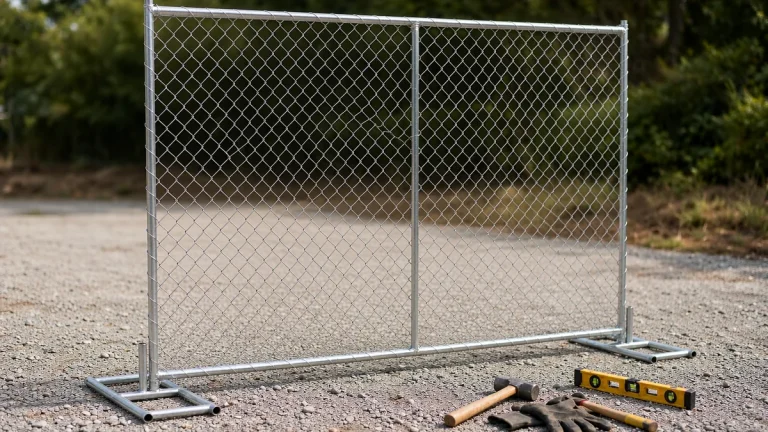
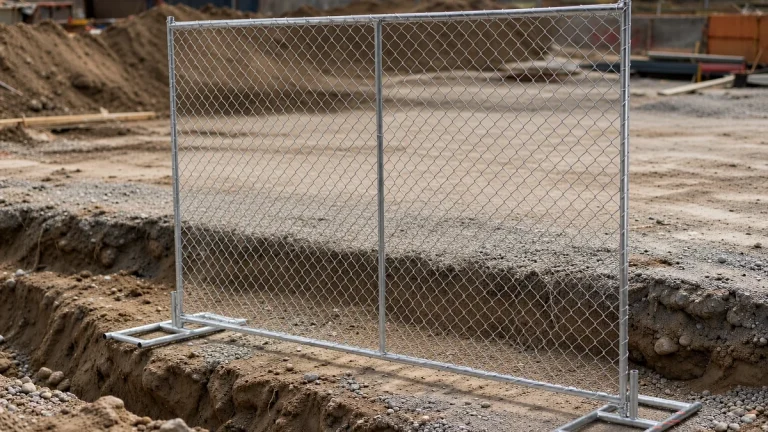
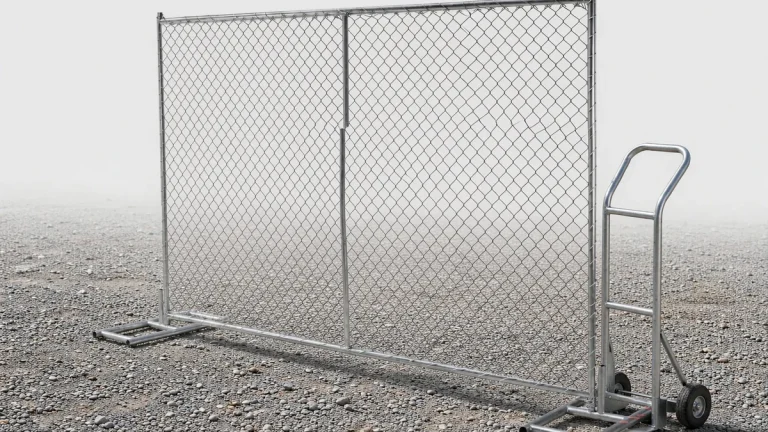
A heavy duty temporary fence panel needs a frame, mesh and welded connections that resist the loads of its intended job, a coating suited to the exposure, and compatible supports that keep the installed fence stable. Compare tube dimensions and wall thickness, wire diameter, mesh opening and coating specification. Use panel weight as a cross-check, then ask for performance evidence covering the complete assembly.
The label alone does not establish a load rating. For example, the published contents of Australia’s AS 4687.2:2022 identify stability classes, importance levels and separate climbing, impact, foothold-aperture and wind tests. A supplier’s “heavy duty” description does not tell you which of those requirements its fence meets. [1]
| Feature | Ask the supplier to state | What it helps you judge |
|---|---|---|
| Frame and rails | Outside dimensions, wall thickness, steel grade and tolerances | Section stiffness and the basis for a strength assessment |
| Mesh | Wire diameter in millimetres, clear opening and attachment details | Steel content, opening size and connection quality |
| Welds and fittings | Weld acceptance criteria, clamp type and compatible components | Whether the assembled fence matches the specified system |
| Coating | Substrate, coating process, thickness or mass, applicable standard and repair method | Corrosion protection and inspection requirements |
| Panel weight | Net panel weight, tolerance and included components | Whether delivered material is consistent with the order |
| Supports and performance | Bases, braces, ballast or anchors, layout and relevant test or design evidence | Stability under the intended site conditions |
Frame Size and Wall Thickness Work Together
A larger outside tube dimension is not enough to compare two panels. You also need its wall thickness and steel grade. For the same material and member length, bending stiffness depends on the section’s second moment of area, not simply on how much the tube weighs.
The examples below use ideal square hollow sections with sharp corners and a steel density of 7,850 kg/m³. The density and elastic modulus of 210,000 N/mm² come from the European Commission JRC’s structural-design handbook. These are calculated section comparisons, not tested panel ratings. [2]
| Tube size and wall, mm | Steel mass, kg/m | Second moment of area, mm⁴ | Relative bending stiffness |
|---|---|---|---|
| 25 × 25 × 1.0 | 0.754 | 9,232 | 1.00 |
| 25 × 25 × 1.5 | 1.107 | 13,031 | 1.41 |
| 30 × 30 × 1.2 | 1.085 | 19,143 | 2.07 |
| 30 × 30 × 1.5 | 1.342 | 23,213 | 2.51 |
| 40 × 40 × 1.5 | 1.813 | 57,153 | 6.19 |
The 30 × 30 × 1.2 mm section has about twice the bending stiffness of the 25 × 25 × 1.0 mm section for 44% more steel per metre. That is useful when comparing quotations, but it does not establish twice the panel strength. Yield strength, local buckling, welds, mesh restraint and connections also affect performance.
Panel width matters too. In an ideal simply supported beam model with the same central point load, elastic deflection scales with the cube of the clear span. Increasing that span from 2.4 m to 2.9 m increases calculated deflection by about 1.76 times. Those are assumed spans, not the exact widths or clear rail spans of the products below. An 8 ft panel is nominally 2.4384 m wide; its clear span depends on its construction.
Wire Diameter, Openings and Welds Matter
Compare millimetres before gauge numbers
Increasing wire diameter from 3.0 mm to 3.8 mm adds about 60% to the steel cross-sectional area of each wire. With a 50 × 100 mm clear opening, the calculated mesh mass rises from about 1.59 to 2.51 kg/m². With a 75 × 150 mm clear opening, the corresponding figures are about 1.07 and 1.71 kg/m².
These estimates use round steel wire, the same steel density as the frame calculation, and wire spacing equal to the clear opening plus the wire diameter. They exclude coating, edge-wire adjustments and fabrication tolerances. They show why changing the opening can offset much of the weight added by thicker wire.
Specify diameter in millimetres even when a quotation uses gauge. The National Bureau of Standards’ wire tables distinguish several gauge systems; the gauge name and number must both be known before a conversion is meaningful. Haisen’s wire mesh size and gauge guide provides purchasing context. [3]
Check the mesh-to-frame connections
Look for detached wires, cracked joints, sharp ends and a distorted frame. Ask for the specified weld and connection acceptance criteria rather than treating a neat-looking weld as a load test. The report or drawing should identify the same mesh, frame, clamps and supports as the supplied fence.
South Australia’s Department for Infrastructure and Transport says panel joints should not weaken the fence, fittings must be securely installed, and gates should provide the same level of security as the fence. Its April 2025 bulletin also describes a 65 kg climbing load held for three minutes and a 37 kg impact mass delivering 150 joules. These are Australian guidance examples, not universal ratings for every product sold as heavy duty. [4]
The same bulletin describes a maximum 75 mm mesh aperture for foothold resistance. For rectangular openings such as 50 × 100 mm, ask for the applicable aperture-test result and the supplier’s compliance explanation. A catalogue dimension alone does not establish a pass under the full test method. [4]
Coating Protects the Steel Through Reuse
“Galvanised” and “powder coated” are incomplete specifications. State the substrate, whether coating occurs before or after fabrication, the required thickness or mass, how it will be checked, and how damaged areas will be repaired. Ask separately about the frame, mesh, weld areas and fittings.
Use a coating standard that applies to the actual manufacturing route. For example, ASTM A123/A123M covers hot-dip zinc coatings on fabricated iron and steel products, including certain tubes fabricated before galvanising and wire work made from uncoated steel wire. That scope does not make it a blanket specification for every pre-coated mesh product. [5]
Coating weight can also affect a weighing check. As an arithmetic example, 390 g/m² applied uniformly over 2.66 m² of surface adds about 1.04 kg of zinc. This is an assumed coating mass and area, not a minimum requirement for every panel. Tube interiors, different component coatings and the actual fabrication geometry change the result.
Corrosion protection helps preserve the steel section; it cannot establish a new panel’s structural capacity. Steel can corrode, bend or suffer connection damage during service. Compare the proposed finish and repair requirements using Haisen’s galvanised versus powder-coated panel guide.
Bases and Braces Decide Fence-Line Stability
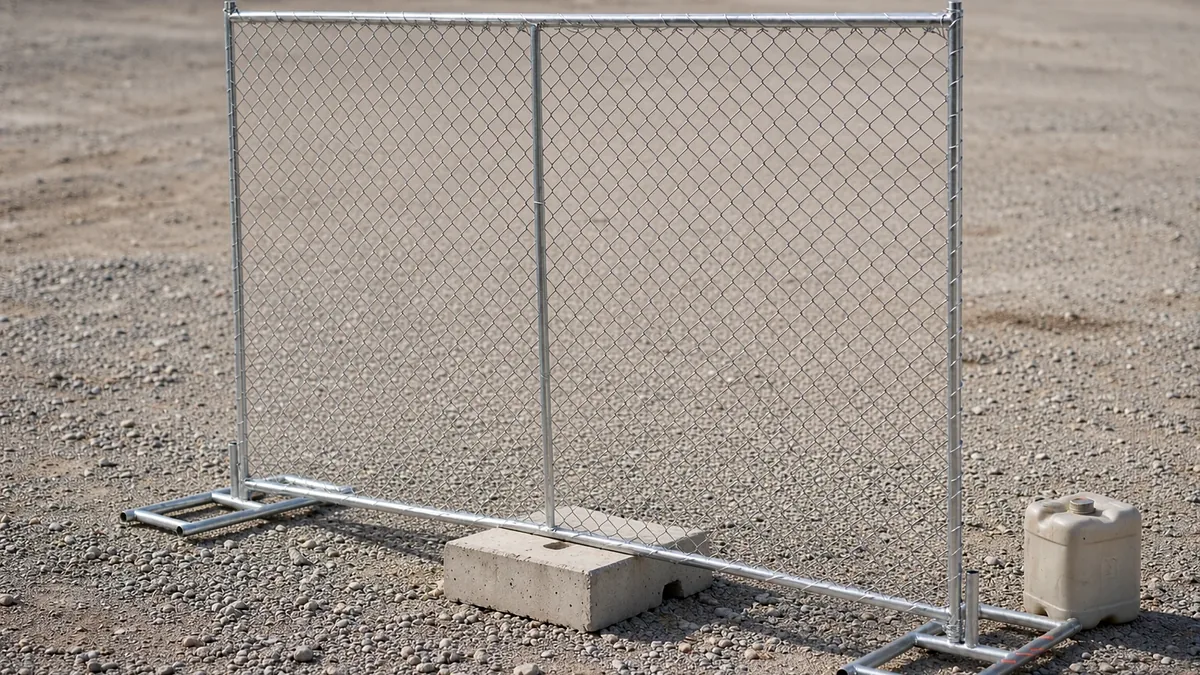
A heavier panel still needs a support arrangement suited to the site. Confirm the base type and footprint, connector arrangement, brace positions, ground support and any specified ballast or anchorage. The South Australian bulletin identifies gateways and terminal panels as locations needing additional bracing. It also warns that shade cloth, signs and other coverings increase wind action. [4]
Wind speed cannot be selected from the words “heavy duty.” AS/NZS 1170.2 sets out procedures for determining wind speeds and wind actions for structural design. The applicable site conditions and fence configuration must be part of that assessment. [6]
For scale, using an assumed air density of 1.225 kg/m³, the equation q = ½ρV² gives dynamic pressures of about 138 Pa at 15 m/s and 932 Pa at 39 m/s. The pressure ratio is 6.76. These are illustrative pressures, not panel wind ratings. Actual fence forces require the appropriate aerodynamic coefficients, exposed area, site and design factors; pressure multiplied by wire area alone is not a complete wind design.
Adding a banner changes the configuration. Get that change assessed before fitting it, even if the uncovered fence already has a test report. Haisen’s installation planning guide helps organise the layout information to send with the enquiry.
What Haisen Publishes and What to Confirm
The temporary fence product page lists the following options in the product information retrieved on 27 October 2026. They describe selectable components, not a tested heavy duty classification.
| Item | Published options |
|---|---|
| Panel size | 6 × 8, 6 × 9.5 or 6 × 10 ft |
| Nominal height | 6 ft, approximately 1,829 mm |
| Wire diameter | 3.0, 3.5 or 3.8 mm |
| Mesh openings | 50 × 100, 50 × 150, 50 × 200, 75 × 100 or 75 × 150 mm |
| Outer frame | 25 × 25 or 30 × 30 mm square tube |
| Middle horizontal pipe | 20 × 20 or 25 × 25 mm square tube |
| Finish | Hot-dip galvanised or powder coated |
| Tube wall thickness | Not stated in the retrieved product specification; confirm in writing |
The missing wall thickness prevents a complete frame comparison. Ask for it together with the steel grade, dimensional tolerances, net panel weight and the proposed base-and-brace package. Do not assume that every listed option is available in every tested assembly.
Height also needs a site-specific check. The South Australian bulletin gives a minimum of 1,800 mm for the temporary construction fencing it describes, with larger fences potentially needed for demolition. A nominal 6 ft panel exceeds that number, but height alone does not prove compliance. [4] In populated areas, UK HSE describes a two-metre small-mesh fence or hoarding as the typical site-boundary solution. The applicable requirement depends on location and risk. [7]
How Much Should a Heavy Duty Panel Weigh?
There is no useful weight threshold without a panel size and construction specification. For a like-for-like illustration, the three constructions below all use one middle rail and 50 × 100 mm clear mesh openings:
- Example A: 25 × 25 × 1.0 mm outer frame and middle rail; 3.0 mm wire.
- Example B: 30 × 30 × 1.2 mm outer frame, 25 × 25 × 1.2 mm middle rail; 3.5 mm wire.
- Example C: 30 × 30 × 1.5 mm outer frame, 25 × 25 × 1.5 mm middle rail; 3.8 mm wire.
| Nominal panel size | Example A, kg | Example B, kg | Example C, kg |
|---|---|---|---|
| 6 × 8 ft | 15.3 | 21.0 | 25.4 |
| 6 × 9.5 ft | 17.7 | 24.2 | 29.2 |
| 6 × 10 ft | 18.5 | 25.3 | 30.5 |
The estimates use 7,850 kg/m³ steel, ideal square-tube sections, the full nominal panel perimeter, one full-width rail and mesh over the full nominal face area. They do not subtract frame overlap or mesh setbacks, and they exclude coating, weld metal, fittings, feet and packaging. Actual cut lengths, corner radii and manufacturing tolerances can move the measured weight in either direction relative to this simplified estimate.
For reproduction, tube mass per metre is [b² − (b − 2t)²] × 0.00785 when b and t are in millimetres. Mesh wire length per square metre is 1/(a + d) + 1/(c + d), with clear openings a and c and wire diameter d expressed in metres. Multiply that length by πd²/4 and the steel density, then by the mesh area.
At 6 × 9.5 ft, Example B contains about 6.5 kg more steel than Example A. The increase comes from both the frame and the mesh; it is not proof of a specific load capacity. The panel weight guide explains the same purchasing distinction between an estimate and a confirmed product weight.
If a sample weighs less than expected, check the dimensions, actual wall and wire sizes, included components and scale accuracy before drawing a conclusion. A discrepancy is a reason to investigate, not automatic proof of a short specification. Compare prices only after those inputs match; Haisen’s panel price guide covers the other delivered-cost variables.
What Published Site Inspections Teach Buyers
The April 2025 South Australian bulletin records unsecured perimeter panels, overgrown vegetation and 900 mm crowd-control barriers used at a deep excavation on a school oval. These are the department’s inspection findings, not Haisen customer cases or tests performed for this article. [4]
Those observations give buyers three practical checks that a steel-weight comparison misses: whether connections remain secured, whether the boundary can be inspected, and whether the selected barrier is suitable for the hazard. The bulletin also requires reusable components to be assessed between installations for fitness for further use. [4]
Turn each return into a condition record
For a rental fleet or used-panel purchase, record the panel ID, inspection date, frame distortion, broken or detached wires, weld damage, coating loss and the condition of matching fittings. Keep the disposition clear: available, awaiting assessment or repair, or withdrawn from use. This is a suggested inspection record, not a report of inspections carried out by Haisen.
Haisen’s storage and transport guide covers handling and return checks, while its panel tracking guide explains how to keep location and serviceable condition together. For a used lot, confirm compatibility before comparing its price with new stock; the used-panel buying guide addresses that purchase decision.
Keep the evidence attached to the configuration
A useful supplier file identifies the panel drawing and revision, material specification, coating documentation, installation instructions and relevant test or design report. Check which bases, clamps, braces, panel spacing and coverings the evidence covers. A report for a different assembly does not establish the performance of the one being quoted.
The evidence available for this article consists of published product information, attributed inspection findings and reproducible calculations. It does not include hands-on testing, measured Haisen samples or a product-specific compliance report.
Where the Heavy Duty Label Is Not Enough
Excavations and fall protection
Do not infer fall-protection suitability from panel weight or mesh size. Where a system is used as an OSHA guardrail, requirements include resistance to at least 890 N at the top edge and 666 N for midrails, screens, mesh and equivalent members. Screens and mesh must also extend from the top rail to the working level and across the opening between supports. These are only part of the requirements in 29 CFR 1926.502(b), not a complete acceptance checklist. [8]
Crowd pressure
UK HSE says barrier selection should account for planned use, layout, ground conditions, weather, wind or crowd loads, and visitor numbers and behaviour. Site-boundary fencing should not be assumed suitable for restraining a crowd. [9]
Livestock and predators
Animal containment needs species-specific height, mesh, gate and ground-level details. Washington State University Extension gives different fence recommendations for different livestock, including 48-inch small-mesh woven wire for sheep and goats. Those recommendations do not certify a portable construction panel for animal use. [10]
University of California extension guidance identifies close stay-wire spacing and control of the bottom gap as important where coyotes or dogs are a concern. A narrow mesh dimension or a 6 ft nominal panel height is not proof of predator exclusion; openings, deformation, climbing and digging routes must be assessed together. [11]
What to Put on the Purchase Order
- Panel geometry: height, width, rail arrangement, mesh opening and dimensional tolerances.
- Materials: frame and rail dimensions, minimum wall thickness, steel grade and wire diameter. Request an agreed inspection method; use a supplied sample or suitable thickness measurement rather than cutting a serviceable panel.
- Connections: weld acceptance criteria, mesh attachments, clamps, gates and compatible replacement fittings.
- Finish: substrate preparation, coating process, thickness or mass requirements, applicable standard, inspection and repair method for each component.
- Weight: net panel weight and tolerance, with bases, hardware and packaging listed separately.
- Installed system: layout, ground conditions, wind design basis, coverings, base specification, braces and any required ballast or anchors.
- Evidence: drawings, installation instructions and relevant test or design documentation identifying the supplied configuration.
Heavy Duty Temporary Fence Panel FAQ
Is a heavier panel always stronger?
No. Extra weight may come from thicker wire, a smaller mesh opening, a larger frame or coating. Compare the frame section, material grade, joints and system evidence before treating weight as an advantage.
Is there a minimum heavy duty wall thickness?
This guide does not establish one. A wall thickness must be considered with tube size, steel grade, span, connections and required performance. Ask the supplier to define what its grade means and write the actual dimensions into the order.
Do heavy duty panels always need sandbags?
Not necessarily. The specified support system may use weighted bases, separate ballast, braces, anchors or a combination. Use the arrangement required for that assembly and site; there is no universal sandbag count per panel.
What is the quickest way to compare two quotes?
Put the panel dimensions, frame and rail walls, wire diameter, mesh opening, coating, net weight and complete support package side by side. Resolve missing values before comparing price. Then check that the performance evidence covers the configuration you intend to install.
Ask for a specification you can check
Send Haisen the panel size, the mesh opening, the wire diameter, the coating mass in g/m² and the tube wall thickness you need written into the order, together with the design wind speed for the site. Ask which of those figures can be confirmed in writing, and which parts of the panel the coating documents cover.
Request a panel specificationReferences
- Standards Australia. AS 4687.2:2022 preview (Standards Australia).
- European Commission JRC. JRC Eurocodes handbook: design of steel structures.
- NIST. NBS Circular 31: wire gauge reference.
- SA Department for Infrastructure and Transport. Safety Share Temporary Fencing April 2025.
- ASTM International. ASTM A123/A123M.
- Standards Australia. AS/NZS 1170.2:2021.
- Health and Safety Executive (UK). Protecting the public.
- Occupational Safety and Health Administration. OSHA 29 CFR 1926.502.
- Health and Safety Executive (UK). Using barriers at events.
- extension.wsu.edu. Farm Fencing Systems for Livestock.
- UC Agriculture and Natural Resources. UC ANR predator-exclusion guidance.