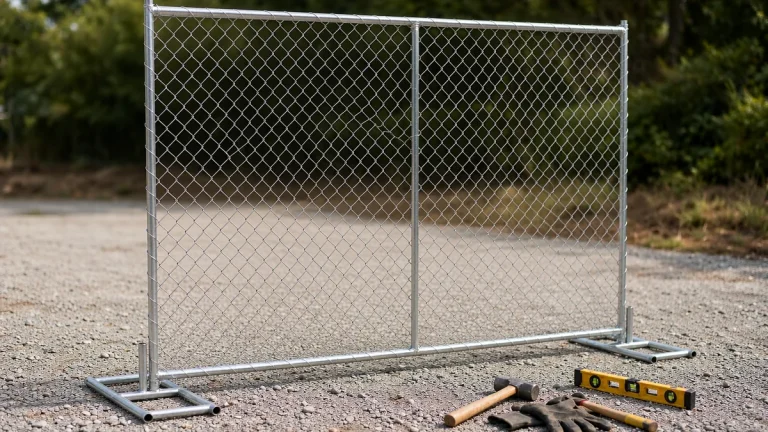
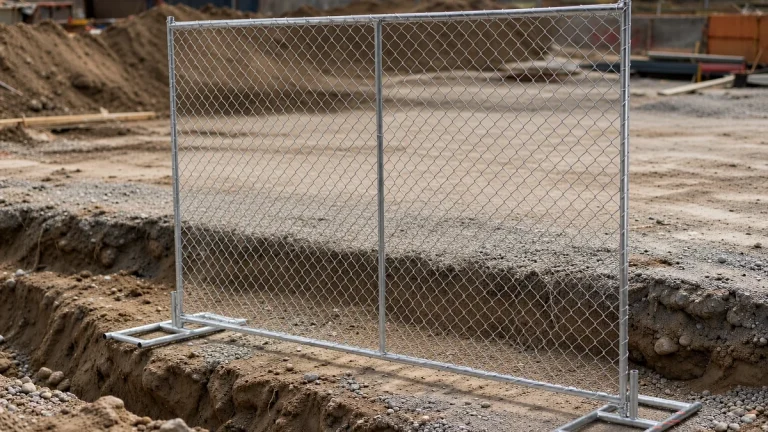
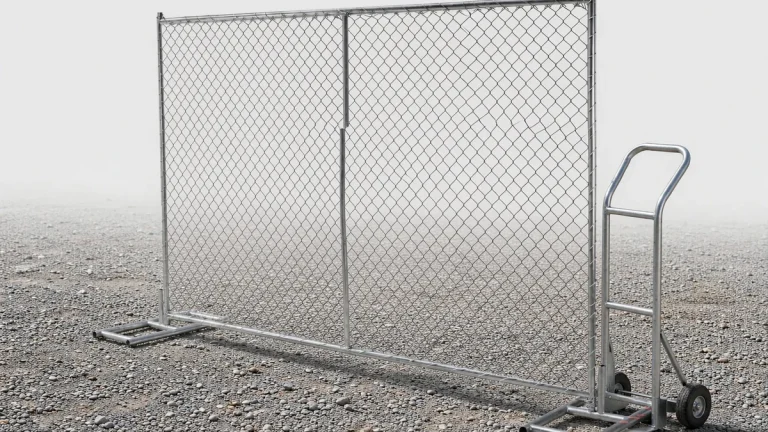
Concrete-filled fence feet are usually better for ballast in a given cavity; lighter plastic-granulate-filled feet are easier to move. Neither is automatically better for the whole fence. Choose the base weight, footprint and support arrangement required for the site first, then compare handling and delivered cost. A lighter base is only a useful substitution if the fence still has adequate stability.
Haisen publishes a 29 kg concrete-filled base example. That does not establish a standard weight for concrete feet—or prove that an equivalent plastic-filled foot weighs 7 kg. The shell weight and fill volume must be known before that comparison can be made.

What does “plastic-filled” mean?
A plastic outer shell can contain concrete. A solid moulded plastic or rubber base is another product altogether. Here, “plastic-filled” means a cavity containing plastic granulate, compared with concrete in the same cavity. Ask the supplier to identify the shell, fill and complete finished weight separately.
Do not confuse a thin protective pad with a substantial rubber base. Haisen’s rubber fence feet guide distinguishes their functions. For our temporary fence panels with detachable feet, confirm the actual base configuration and connection details in the quotation.
How do the two fills compare?
| Buying question | Concrete-filled base | Plastic-granulate-filled base |
|---|---|---|
| Which provides more ballast? | More fill mass in an equal cavity using the reference densities below. | Less fill mass; check whether additional support is required. |
| Which is easier to relocate? | The heavier base adds lifting and loading work. | A lighter finished base reduces the mass handled, but does not establish that a lift is safe. |
| Which costs less to deliver? | Compare the complete shipment, including packaging and unloading. | May reduce cargo mass; savings depend on the carrier’s charging basis and packing constraints. |
| Which protects a finished floor? | Check the contact surface, footprint, debris and load. | The same checks apply. Internal granulate does not make the outer shell non-marking. |
| Which is better outdoors? | Specify concrete durability for the exposure. | Check the shell’s temperature range, impact performance, UV exposure data and fill retention. |
| Can the fills be exchanged? | Only where the manufacturer permits it. Equal cavity size does not establish equal structural performance. | |
How much weight does the fill add?
A FHWA concrete material-model manual uses a normal-weight concrete density of 2,286 kg/m³, or 2.286 kg/L. This is a calculation reference, not a specification for a fence-foot mix. Chapt2c.cfm
A polymer study reports bulk densities of 0.525 kg/L for its primary PP_cast granulate and 0.492 kg/L for its recycled metallized PP granulate. These are different materials. Neither value describes all recycled plastic fills, and solid polymer density cannot replace bulk density when calculating a cavity filled with loose granules. PMC11051470
| Reference fill | Density used | Fill mass in an assumed 10 L cavity |
|---|---|---|
| Normal-weight concrete | 2.286 kg/L | 22.86 kg |
| Primary PP_cast granulate | 0.525 kg/L | 5.25 kg |
| Recycled metallized PP granulate | 0.492 kg/L | 4.92 kg |
The 10 L cavity is an illustrative assumption, not a measured Haisen foot. In that cavity, the concrete fill weighs 17.61 kg more than the primary PP granulate. Add the shell, inserts and other retained hardware to each fill mass to obtain the finished base weight. Actual packing, moisture and the specified concrete mix can change the result.
Why the 29 kg example does not prove a 7 kg alternative
Our panel weight guide lists a 14 kg rental panel, a 29 kg complete concrete-filled base and an approximately 1 kg clamp: about 44 kg altogether. These are hypothetical component masses, not independently weighed samples or verified product specifications. The 29 kg includes the shell and hardware.
For the same shell and fully filled cavity, use these equations with density in kg/L:
- Cavity volume in litres = (complete concrete base mass − empty shell and retained hardware mass) ÷ concrete density.
- Alternative complete base mass = empty shell and retained hardware mass + cavity volume × alternative bulk fill density.
Ignoring the shell entirely gives 29 ÷ 2.286 ≈ 12.69 L and 12.69 × 0.525 ≈ 6.66 kg of primary PP granulate. Under those density assumptions, 12.69 L is an upper bound on cavity volume, and about 22.34 kg is an upper bound on the mass reduction. The 6.66 kg result is not the weight of a finished plastic-filled foot.
For example, if the shell and retained hardware weighed an assumed 2 kg, the cavity would be about 11.81 L. The alternative complete base would weigh about 8.20 kg, saving 20.80 kg. The 2 kg shell is an illustration, not a product specification. Without the actual empty-shell mass or measured cavity volume, there is no reliable finished-weight quotation.
Does a heavier base make the fence safer in wind?
More mass can increase resistance to overturning when the geometry and other conditions are unchanged. It does not establish a wind rating. Panel height, mesh or screening, base footprint, connections, braces, anchors and ground conditions all affect the installed system.
WorkSafe Victoria says proprietary construction-site fencing should follow the manufacturer’s specifications and withstand anticipated loads, including strong winds. Signage and shade-cloth coverings may require extra support. This is Victorian guidance, not certification of a particular base. Construction site security fencing
For events, Britain’s HSE includes planned use, layout, ground conditions, underground services, weather, wind and crowd pressure among the factors in barrier selection. A fence intended to mark a boundary should not be assumed suitable for crowd restraint. Using barriers.htm
Use the supplier’s support layout for the actual panel and site. Do not replace concrete with lighter granulate merely because both fit the shell. Haisen’s installation planning guide treats bases, connections, braces and gates as one system.
On soft ground, adding weight can worsen sinking rather than solve it. Investigate bearing area, drainage and the support surface; distinguish sinking from sliding, rocking and tipping, as in our guide to moving fence feet. Where anchors require ground penetration, locate services first. For US excavation work, OSHA requires the estimated locations of utility installations to be determined before excavation begins. 1926.651
Which is easier to handle and install?
A lighter complete base reduces the load lifted at each move. The Revised NIOSH Lifting Equation starts with a 23 kg load constant for an ideal two-handed lifting task, then applies task-related multipliers. A 29 kg base exceeds that starting value, but the equation is not a universal legal weight limit or a guarantee that a lighter load is safe. 94 110
Assess the finished weight, grip, reach, carrying distance, frequency and placement height. HSE states that manual-handling law does not set specific weight limits. Plan suitable lifting or transport aids for heavy or repetitive handling; simply assigning two people does not replace assessment. Index.htm
Factory-cured concrete bases avoid on-site filling and curing. Ready-mixed concrete is still fresh concrete: it needs placing and curing. Fill on site only where the base manufacturer allows it and provides the mix, filling and readiness-for-use requirements.
For covered US construction work involving respirable crystalline silica exposure, OSHA specifies a permissible exposure limit of 50 µg/m³ and an action level of 25 µg/m³, both as eight-hour time-weighted averages. These are airborne exposure limits, not measurements of dust from a particular filling operation. 1926.1153
Will lighter feet reduce the delivered cost?
They reduce cargo mass if the finished base is lighter. They do not necessarily reduce the number of containers, pallet positions or truck journeys. Compare freight quotations using the actual packed dimensions and total shipment weight, including racks and fittings.
Our temporary fence price guide uses a straight 500 ft run of 50 ten-foot panels and 51 support positions. That count is a layout assumption, not a universal one-base-per-panel rule. Using the assumed 2 kg shell example above, 51 bases would save about 1.06 tonnes. Additional ballast or bracing needed by the lighter configuration must be added back before comparing shipments.
Ask for both configurations on the same basis: panels, bases, connectors, braces, gates, packaging, delivery and unloading. Our storage and transport guide also calls for checks on available vehicle payload, gross vehicle weight and axle loads.
Which fill lasts longer outdoors?
Concrete-filled bases
Freeze-thaw resistance depends on the concrete and its exposure to moisture. FHWA explains that freezing can damage critically saturated concrete and that an appropriate entrained-air system provides pressure-relief space. This mechanism does not establish a service life for a fence foot. Hif17009.pdf
Ask for the specified mix density, strength and exposure requirements. ASTM C94/C94M covers ready-mixed concrete; it does not by itself certify a finished fence base or specify the correct mix for every site. Inspect for cracking, loose material and damaged post sockets before reuse. C0094_c0094m 24
Plastic-granulate-filled bases
The shell must retain the fill and maintain its connections through handling and outdoor exposure. Ask for the polymer, wall construction, service-temperature range and relevant test results. ASTM D256 covers Izod impact testing, while ASTM G154 describes fluorescent-UV exposure apparatus operation. Neither standard alone supplies a whole-base load rating or a number of years outdoors. D0256 23 G0154 23
Do not treat plastic granulate and water fill as interchangeable. Water expands on freezing; USGS notes that ice is about 9% less dense than liquid water. A water-filled shell needs the manufacturer’s cold-weather filling and storage instructions. Water density
What can Haisen’s published examples tell you?
Our available evidence is published product information and worked planning examples, not a controlled field comparison of concrete and plastic-filled feet. The rental investment guide uses 530 sets, each with a 14 kg panel, 29 kg base and approximately 1 kg clamp. The bases total 15,370 kg out of 23,320 kg of components—about 66%. This shows why base weight deserves its own line in a transport calculation; it is not a measured shipment or a container-capacity guarantee.
The practical purchasing lesson is to request a component-weight schedule, not just a panel weight. Ask the supplier to identify the empty shell, fill, complete base, panel and fittings separately, then reconcile the packed load against the order. For a sample base, record its measured finished weight alongside the quoted value before using that figure across a fleet.
Our rental tracking guide recommends counting bases, clamps, gates and braces separately from panels. Applied to this purchase, that means recording both the base type and its usable condition: a returned panel does not establish that its correct base came back too. This is a documented planning approach, not a claim that Haisen ran a rental trial.
What should you specify before ordering?
- Product identity: base drawing, shell material, fill type, post-hole dimensions and panel compatibility.
- Weight: empty-shell and complete-base masses, cavity volume, fill density and stated tolerances.
- Site support: required base quantity and arrangement, bracing, anchoring, ground conditions and screening restrictions.
- Handling: grip points, lifting aids, pallet quantities, packed dimensions and unloading arrangements.
- Durability: concrete exposure specification or plastic temperature, impact and UV evidence, plus inspection and replacement criteria.
- Surface contact: footprint, floor-protection layer and acceptance by the floor owner. Neither fill guarantees a non-marking base.
Beside animal enclosures, stable support is only part of the decision. Check exposed edges, gaps and access for cleaning. US Animal Welfare Act rules for covered dog and cat facilities require structurally sound primary enclosures, secure containment and floors that protect feet and legs; they do not approve a particular fence-foot fill. Section 3.6
Which should you buy?
Choose concrete-filled feet where the specified fence system needs their ballast. Choose lighter plastic-filled feet where the complete support design allows them and frequent handling makes the weight reduction worthwhile. For finished floors or cold sites, assess the contact surface and exposure requirements separately. The decisive comparison is the installed system and its measured component weights—not a promise that every concrete foot weighs 29 kg or every plastic-filled foot weighs 7 kg.
Haisen’s company page identifies Hebei Haisen Fence Products Co., Ltd as a fencing and enclosure manufacturer. The examples above are attributed to our published guides; material data and regulatory guidance are linked separately. No independent handling trial, wind test or service-life test is claimed here.
Send your panel dimensions, run length, ground conditions, screening plans and relocation frequency. Ask us to confirm the base configuration and finished weight in your quotation.
Ask Haisen about fence feetReferences
- Federal Highway Administration. Chapt2c.cfm.
- National Library of Medicine. PMC11051470.
- WorkSafe Victoria. Construction site security fencing.
- Health and Safety Executive (UK). Using barriers at events.
- Occupational Safety and Health Administration. OSHA 29 CFR 1926.651.
- Centers for Disease Control and Prevention. Docs.
- Health and Safety Executive (UK). Manual handling at work.
- Occupational Safety and Health Administration. OSHA 29 CFR 1926.1153.
- Federal Highway Administration. Hif17009.
- ASTM International. ASTM C94/C94M Standard Specification for Ready-Mixed Concrete.
- ASTM International. ASTM D256 Standard Test Methods for Determining the Izod Pendulum Impact Resistance of Plastics.
- ASTM International. ASTM G154 Standard Practice for Operating Fluorescent Ultraviolet (UV) Lamp Apparatus for Exposure of Materials.
- US Geological Survey. Water Density.
- Electronic Code of Federal Regulations. Section 3.6.